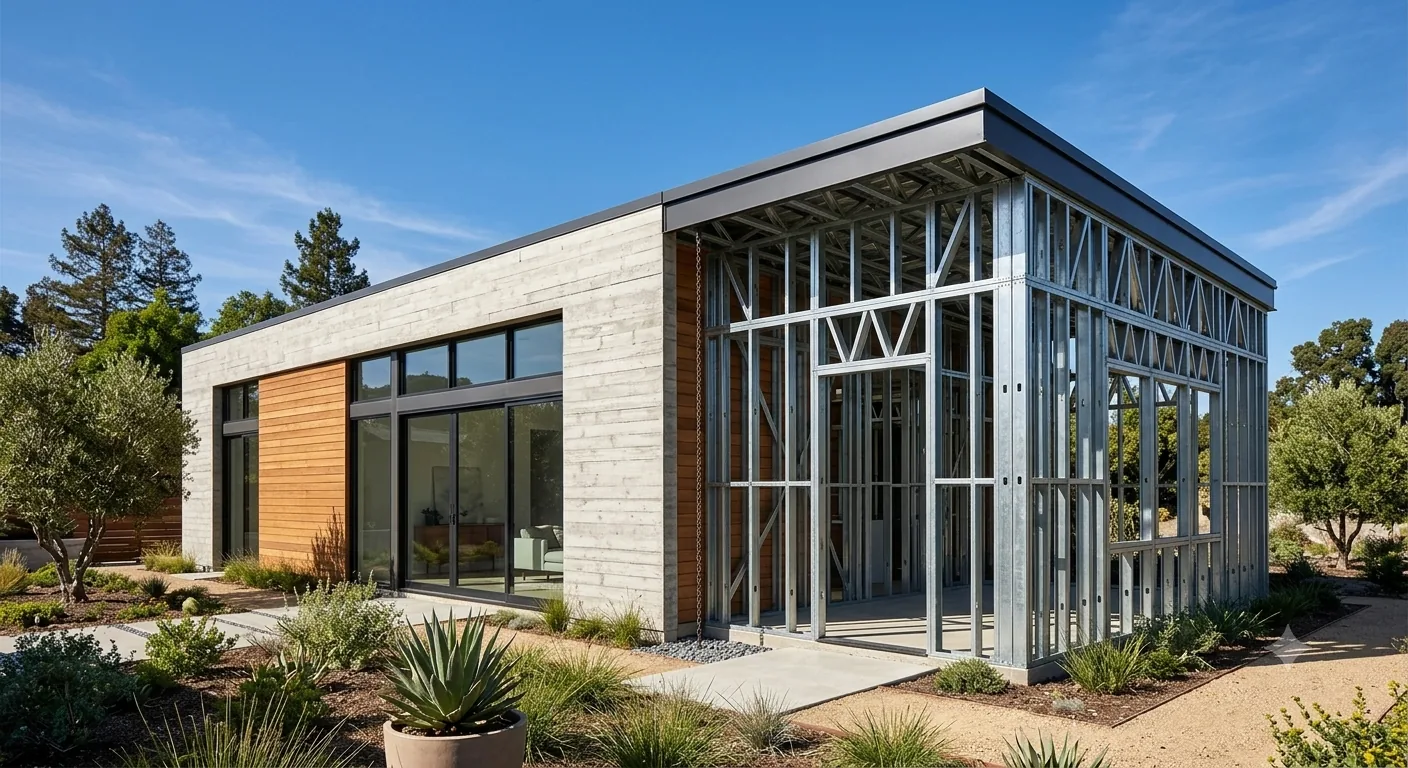
Most California luxury homes built in 2026 are still framed in wood. Including, remarkably, new builds going up in the same fire zones that lost over 16,000 structures in 2025 (CAL FIRE).
The math on light gauge steel frame vs wood frame in California has shifted, quietly, but decisively. Insurance carriers are exiting the wood-frame fire-zone market. Building codes are tightening every cycle. Architects who would never have specified steel five years ago are quietly redrawing for it.
This guide is the comparison your average GC won't sit you down for. Written by a contractor who has personally built with both. No marketing. No greenwashing. Just the numbers, the code, and the reality.
The short answer: for a California custom home, especially in a fire zone, light gauge steel frame outperforms wood frame on fire resistance, seismic performance, lifespan, pest and mold resistance, and long-term insurability. Wood still wins on upfront framing cost and on the number of local crews who know it. Here is the full picture at a glance:
| Factor | Light Gauge Steel Frame | Wood Frame |
|---|---|---|
| Fire | Non-combustible | Combustible, ignites near 500°F, becomes the fuel |
| Seismic | Ductile, shake-table tested at high seismic demand, recovers elastically | Code-minimum, racks and splits under repeated load |
| Termites and mold | Immune to both | Susceptible, recurring treatment and remediation |
| Dimensional stability | Does not warp, shrink, or twist | Expands, contracts, and warps with moisture |
| Lifespan | Engineered for a longer service life than wood frame | Shorter service life, degrades with moisture and pests |
| Insurability (CA fire zones) | Stronger, non-combustible classification supports coverage | Increasingly hard to insure in WUI zones |
| Framing speed | Faster with pre-engineered panels | Slower, cut and assembled on site |
| Upfront framing cost | Single-digit percentage premium | Lower at the framing line |
| Job-site waste | Low (2 to 3%), steel is recyclable | Higher, up to ~20% |
| Crew availability | Fewer crews, ESRL self-performs | Widely available |
"The frame decides how the next fire ends. Light gauge steel is non-combustible, while wood ignites near 500 and becomes the fuel. In a California fire zone, that is not a preference. It is the whole decision."
- What "light gauge steel frame" actually means
- Fire performance: non-combustible vs combustible
- Seismic: engineered to current California seismic code
- Cost: framing line vs total cost of ownership
- Insurance: the regulated discount reality
- Schedule: 1 day vs 2 weeks
- Lifespan, mold, termites, movement
- The honest objections to steel
- When wood is still right (and when it isn't)
1. What "light gauge steel frame" actually means
"Light gauge steel" (LGS), also called "cold-formed steel" (CFS), refers to thin galvanized steel sheet, typically 14 to 18 gauge, run through automated roll-forming lines at room temperature to produce structural shapes (C-studs, joists, tracks, headers, and pre-engineered trusses). It is the steel equivalent of a wood 2x4, used the same way: walls, floors, roofs.
LGS is not hot-rolled structural steel, the heavy I-beams in commercial buildings. Those are different products with different applications. LGS is purpose-built for residential and light commercial framing, with sections engineered to match wood-stud spans while delivering the structural properties of steel: an exceptional strength-to-weight ratio, elastic recovery under load, and a dimensional accuracy that wood simply cannot match.
That accuracy is the part wood framers struggle with most. LGS members are manufactured to a tolerance of roughly 1/256 of an inch. The same 8-foot stud, produced on Tuesday and Friday, is identical. Walls plumb the first time. Door bucks square the first time. The math the architect drew is the math that gets built.
In California, LGS is fully recognized under the California Building Code (CBC) and California Residential Code (CRC). It is conventionally permitted, conventionally inspected by LADBS or OC Public Works, and conventionally financed by every major California lender. It is not exotic. It is a code-mainstream material that most California residential GCs have simply never built with.
2. Fire performance: non-combustible vs combustible
This is the headline. Steel is non-combustible. Wood is combustible. The numbers:
| Property | Light Gauge Steel | Wood Frame |
|---|---|---|
| Ignition temperature | Does not ignite (non-combustible) | ~500°F (Class A through C) |
| Loss of structural strength | Non-combustible | ~500°F (begins charring) |
| Contributes to fire load | No | Yes, primary fuel |
| CBC Chapter 7A (WUI) compliance | Inherent | Requires extensive treatment + assemblies |
The 2025 Pacific Palisades and Eaton fires destroyed over 16,000 structures. Per Cal Fire's preliminary damage assessments, the overwhelming majority were wood-frame residential. Among the small population of steel-frame and steel-stud homes in the affected zones, structural survival rates were dramatically higher.
For homes in Wildland-Urban Interface (WUI) zones. Pacific Palisades, Malibu, Bel Air, Calabasas, Altadena, light gauge steel framing is the structural choice that aligns with where the code is heading. We've covered the specifics in our Steel Frame overview.
3. Seismic: shake-table tested at high seismic demand
California is seismic zone D. Every residential structure in the state must perform under earthquake loads. The question isn't whether your house can resist a code-level event, it's how much margin you have.
Light gauge steel framing has been lab-tested to simulated high seismic demand events with elastic recovery, the structure flexes under load and returns to position. Wood, by contrast, is a brittle material in seismic terms: it absorbs energy through plastic deformation (failure of nail connections, splitting) rather than elastic flex.
For a code-minimum event, both systems pass. For a once-in-a-century event, steel-framed homes are likely to retain residual structural capacity that allows reoccupation; wood-framed homes more often require demolition. Insurance underwriters know this. Increasingly, so do buyers.
4. Cost: framing line vs total cost of ownership
This is where the conversation usually gets dishonest. Most GCs quote you the framing line and stop there. Here's the full picture:
At the framing line (one trade)
Light gauge steel costs 3-7% more than wood for an equivalent residential structure in California, in 2026. That gap has narrowed dramatically over the last decade as steel prices stabilized and lumber prices stayed volatile. At the height of the 2021 lumber spike, steel was actually cheaper.
The premium is meaningful but not transformative on a high-value custom home budget. And the gap closes further when steel is procured well. ESRL sources panels manufacturer-direct from qualified, ICC-ES certified domestic mills, with no middle distributor and no markup stacked on the steel itself. The material cost a panel shop would pay is the material cost we build with. ESRL provides project-specific pricing during free pre-construction consultation, every project is scoped on its own merits, because every project is different.
Total cost of ownership (50 years)
Now run the rest of the math:
- Foundation savings: Steel is lighter than wood. Smaller foundation, less concrete, less excavation. Real cost reduction on a custom home, visible in the slab line of the budget.
- Insurance savings: State-required hardening discounts. On a high-value California home, this typically exceeds the entire framing-line premium many times over within the first decade.
- Termite treatment avoided: Thousands of dollars over the home's life. Mold remediation risk avoided: a meaningful probabilistic cost in coastal and humid zones.
- Lower lifecycle maintenance: No warping, splitting, expansion gaps in finishes.
- Resale: Non-combustible classification is an increasingly disclosable, increasingly valued feature in CA real estate.
By year 5, steel typically pencils out at parity. By year 10, it's clearly ahead. Over the longer service life than traditional wood frame, the gap is multiples of the framing-line premium.
5. Insurance: the regulated discount reality
This is the lever that has shifted the conversation faster than any other. As of 2026, California's residential insurance market is in crisis:
- State Farm, Allstate, AIG, and Liberty Mutual have all paused or limited new homeowner policies in CA fire-exposed areas.
- The California FAIR Plan (last-resort coverage) has tripled enrollment since 2020.
- Available policies for wood-frame homes in fire zones run at multiples of historical premiums, when coverage is available at all.
Non-combustible structural classification is the most material discount carriers will offer. Filed hardening discounts typically run set by your carrier. Some carriers are quietly only renewing in fire zones with non-combustible structural specifications.
If you're rebuilding in a fire zone. Pacific Palisades, Malibu, Altadena, the insurance math alone often makes steel frame the rational default, before factoring in any other consideration.
6. Schedule: 1 day vs 2 weeks
A 2,000 SF light gauge steel frame, prefabricated in panels and delivered to site, can be erected in approximately one day. The same area in conventional wood stick-framing takes 1-2 weeks.
The speed comes from panelization, which is how LGS is delivered in 2026. Wall panels, floor cassettes, and pre-engineered roof trusses are cold-formed and assembled in a controlled fabrication environment, then trucked to the job site as a complete kit-of-parts. The on-site crew is small, the cuts are already made, and the geometry is already plumb. Industry data consistently shows panelization reducing structural shell build time by roughly 50% compared to stick framing.
Why this matters isn't just frame speed, it's the compounding effect on every subsequent trade. MEP rough-ins start sooner. Drywall starts sooner. Finishes start sooner. On a 12-18 month custom home schedule, two weeks at the framing line typically translates to 4-6 weeks earlier completion, with everything that implies for soft costs (loan interest, supervision, opportunity cost).
7. Lifespan, mold, termites, movement
| Property | Light Gauge Steel | Wood Frame |
|---|---|---|
| Termite vulnerability | None, inorganic | Lifetime treatment required |
| Mold susceptibility | None, no organic substrate | Meaningful remediation risk |
| Dimensional movement | Effectively zero | Warps, shrinks, expands seasonally |
| Documented service life | 100+ years | ~50-80 years |
| Service life | Longer than wood frame | 50 to 80 years typical |
For coastal California homes. Newport Beach, Laguna, Malibu, Pacific Palisades, termite and mold pressure on wood framing is high. Galvanized steel framing inside a properly-detailed envelope simply doesn't have these failure modes.
8. The honest objections to steel
This guide isn't a pitch. Here are the legitimate objections to light gauge steel frame, addressed honestly:
"Doesn't steel rust?"
Modern LGS is galvanized (zinc-coated). Inside a properly-detailed envelope (sheathed, weather-resistive barrier, conditioned interior), there is no environment for rust. 100+ year service life is well-documented. Not an issue when properly built.
"It conducts heat, energy performance?"
Steel does conduct more than wood, about 400x more. The solution is exterior continuous insulation (a Title 24-aligned best practice anyway), which thermally breaks the studs. With proper detailing, steel-framed homes meet or exceed Title 24 envelope performance.
"My GC says they 'can do' steel frame."
Most GCs in LA and OC have not actually built a steel-framed home. They will subcontract it to someone who has, often without an established supply chain or crew training. The cost overruns and schedule problems that get blamed on "steel" are usually GC inexperience problems. ESRL is one of the few residential GCs in LA/OC with hands-on light gauge steel experience.
"What about appraisals and resale?"
Steel-frame homes are conventionally appraised at the same standards as wood-frame homes. Resale is not a structural problem, buyers don't generally know or care what's behind the drywall, and disclosure of non-combustible structural classification is increasingly a positive in fire zones.
9. When wood is still right (and when it isn't)
Wood frame is still the right answer for:
- Smaller projects in low-fire-risk inland zones where insurance pressure is minimal
- Tight budget projects where the 3-7% framing premium can't be absorbed
- Vernacular projects (rustic, traditional, log-style) where wood is part of the architectural intent
Steel frame is the rational default for:
- Any project in a California Wildland-Urban Interface (WUI) zone
- Coastal projects with termite and moisture pressure
- High-value custom homes where lifecycle cost dominates the budget
- Projects where insurance is a known constraint
- Architect-driven modern homes with long spans, large openings, or exposed structure
Five years ago this article would have read differently. Five years from now, it'll read as obvious. We're in the transition. The architects, developers, and homeowners moving early are the ones who will own the better-positioned residential assets in California's next chapter.
Frequently Asked Questions
Is steel frame more expensive than wood frame in California?
At the framing line, light gauge steel typically costs 3-7% more than wood frame in California. Total cost of ownership favors steel: state-required hardening insurance discounts, no termite/mold remediation, smaller foundation (steel is lighter), and a longer service life than traditional wood frame.
Can wood frame survive a wildfire as well as steel frame?
No. Wood ignites at approximately 500°F. Steel is non-combustible and does not feed a fire. Per CAL FIRE damage assessments, the 2025 California fires destroyed over 16,000 structures, nearly all wood-frame. Non-combustible classification is the most material protection homeowners can specify in fire-zone construction.
Is steel frame stronger than wood frame in earthquakes?
Yes. Light gauge steel framing is shake-table tested at high seismic demand (the CFS-NEES program). Steel flexes elastically under load rather than failing brittlely. In California's seismic zones, steel frame provides demonstrably higher residual capacity after major events than code-minimum wood framing.
Do wood frame homes have higher insurance costs in California?
Increasingly yes, particularly in California fire zones. Major carriers are exiting CA fire-zone wood-frame markets entirely. Hardened, non-combustible homes earn state-required wildfire discounts, where coverage is still available.
How much faster is a steel frame house to build?
A 2,000 square foot light gauge steel frame can be erected in approximately one day using prefabricated panels, versus 1-2 weeks for equivalent wood framing. The compounding effect on the schedule is significant: every subsequent trade phase starts sooner.
Do steel frame houses rust?
No, when properly detailed. Modern light gauge steel framing is galvanized (zinc-coated) and protected within the building envelope. Documented service life exceeds 100 years.
Can architects design freely with light gauge steel?
Yes, and often more freely. Steel achieves longer clear spans (40+ ft is conventional), supports larger openings, and accommodates cantilever conditions that would require engineered lumber or steel beams in wood construction. Most modern residential architecture is easier to execute in steel.
Considering steel frame for your next California build?
ESRL Development is one of the few residential GCs in LA & OC with hands-on light gauge steel frame experience. Owner-led from first specification to final walk-through.
Begin a project ↗