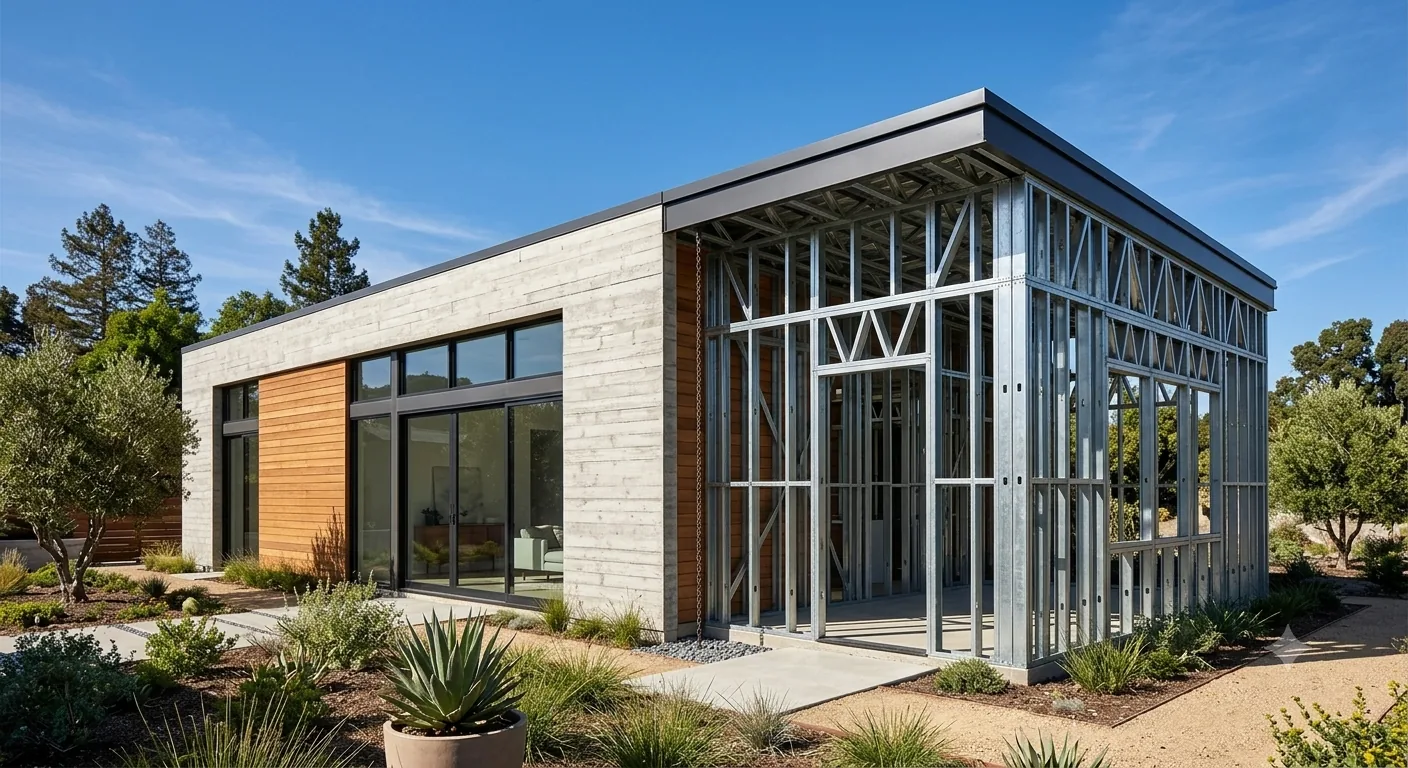
The case for light gauge steel frame is usually presented as ten bullet points on a contractor's website. Fire. Earthquake. Termites. Done.
The real case is bigger, and the parts that don't make the bullet list often matter more. The lifetime money math. The indoor health impact. The resale and insurance reality California is quietly settling into.
This is the long version. Fifteen documented benefits, grouped honestly, with real numbers attached where they exist. Written by a contractor who has personally built with the material, not a marketing department.
If you're an architect specifying for a fire-zone client, a homeowner rebuilding after the 2025 fires, or a developer evaluating long-hold residential, this is the article that should sit in your reference folder.
The short answer: The main benefits of light gauge steel framing are that it is non-combustible (rated to ASTM E136, where wood ignites near 500°F), seismic-resilient (shake-table tested at high seismic demand), mold-proof and termite-proof because it is inorganic, and free of the formaldehyde and VOC off-gassing of engineered lumber. It is lighter than wood framing (allowing a smaller foundation), qualifies for California's wildfire hardening insurance discounts, and is recyclable with only 2-3% job-site waste. Steel is engineered for a longer service life than traditional wood frame, so a modest single-digit percentage framing premium is offset by significant lifetime savings.
| Benefit | What it means |
|---|---|
| Fire-resistant | Non-combustible (wood ignites near 500°F) |
| Seismic-resilient | Lab-tested to a simulated high seismic demand event with elastic recovery |
| Mold-proof | Inorganic, removes the organic substrate mold needs to grow |
| Termite-proof | Contains no cellulose, so no pest damage and no lifetime termite treatment |
| Healthier air | No formaldehyde or VOC off-gassing from the structural framing |
| Lighter structure | Lighter than wood, allowing a smaller foundation |
| Insurance savings | Qualifies for California's wildfire hardening discounts |
| Sustainable | Recyclable with only 2-3% job-site waste, no deforestation |
| Longer service life | Engineered for a longer service life than traditional wood frame |
"People compare steel and wood at the framing line and stop there. Over the life of the home, light gauge steel is immune to termites and mold, does not warp, produces 2 to 3 percent job-site waste against up to 20 for wood, and is engineered for a longer service life. The real savings is the cost you never pay again."
- Safety benefits (fire, seismic, wind)
- Health benefits (mold, chemicals, indoor air)
- Financial benefits (insurance, foundation, schedule, warranty)
- Performance benefits (movement, spans, pests)
- The way it's made (precision, panelization, supply chain)
- Environmental benefits (waste, recycling, deforestation)
- The 25-year money math (real numbers)
- Health deep dive: what living in a steel-frame home actually means
- Honest objections, addressed
- FAQ
1. Safety benefits
Fire-resistant, non-combustible structural classification
Steel does not ignite. It does not contribute to fire load. It does not add fuel to a fire. Wood ignites at roughly 500°F and is itself the primary fuel in a structure fire. In California Wildland-Urban Interface (WUI) zones, this is no longer a marginal benefit, it's the difference between a home that survives an event and one that becomes a casualty statistic.
Seismic-resilient, flexes elastically under earthquake load
Light gauge steel framing has been lab-tested to simulated high seismic demand events with elastic recovery. Steel flexes under load and returns to position; wood absorbs seismic energy through plastic deformation, splitting, nail-pull, sheathing failure. For California's seismic reality, that distinction matters most in the rare events: a steel-frame home is far more likely to retain reoccupable structural capacity after a major quake.
Wind- and storm-resilient, superior uplift resistance
Steel-to-steel screwed connections deliver significantly higher uplift and lateral capacity than nailed wood-to-wood connections. While Southern California isn't hurricane country, Santa Ana wind events, coastal exposure, and increasingly volatile weather make this a meaningful margin. Steel-frame homes in coastal Florida and Gulf Coast hurricane zones have documented survival data far in excess of wood-frame counterparts.
2. Health benefits, the part most contractors don't talk about
This is the section that doesn't appear on most contractor websites. Light gauge steel construction has measurable, documented health implications for the people who live inside the home. For families with asthma, allergies, chemical sensitivities, or young children, these benefits often outweigh everything else.
Mold-proof structural cavity, eliminated indoor mold risk at the framing level
Mold needs three things to grow: moisture, oxygen, and an organic substrate. Steel removes the substrate. Wood framing inside walls is the primary indoor mold-growth medium in residential construction. Coastal California homes. Newport Beach, Malibu, Pacific Palisades, face the highest indoor mold pressure in the country, and structural mold in wood-frame homes is the leading cause of "mystery" respiratory complaints in those zip codes. Steel-framed cavities cannot host mold at the structural level.
Chemical-free pest protection, no termite treatments, ever
Wood-frame homes in California typically receive lifetime termite treatments using compounds like fipronil, imidacloprid, and bifenthrin. These pesticides are sprayed in soil, injected into wall cavities, and re-applied every 5-10 years. Their long-term human exposure profiles, particularly for young children and pets, are non-trivial. Steel doesn't need any of it. Zero pesticide exposure in your home's structural envelope, for life.
No formaldehyde or VOC off-gassing from structural framing
Modern wood-frame construction relies heavily on engineered lumber: OSB, plywood, glulams, I-joists, LVLs. These products use urea-formaldehyde and phenol-formaldehyde adhesives that off-gas volatile organic compounds for years after construction. Treated lumber adds another chemical layer. Steel framing introduces none of these compounds into the building envelope. A steel-framed home can achieve markedly lower indoor VOC levels, measurably better air quality, particularly in the first 2-5 years after construction.
Cleaner indoor air over the home's lifetime
Wood structural framing is a long-term reservoir for dust, organic decomposition products, and microbial activity. Even in a perfectly sealed envelope, wood-frame homes show measurable indoor airborne particulate from the structural cavity over decades. Steel is inert. It does not decompose, does not feed microbes, does not shed organic dust. For homeowners with asthma, allergies, or respiratory sensitivity, this is one of the most underappreciated benefits of steel-frame construction.
3. Financial benefits, where the lifetime math actually lives
Wildfire hardening discounts required by California regulation, with the amount set by your carrier
Non-combustible structural classification is the single largest discount carriers offer in fire-exposed California zip codes. With major carriers (State Farm, Allstate, AIG) actively exiting wood-frame fire-zone markets, this is increasingly the difference between obtaining coverage and being forced onto the FAIR Plan at multiples of the cost. On a high-value Pacific Palisades or Malibu home, 10-year insurance savings can be substantial, often exceeding the entire framing-line premium many times over.
Smaller foundation, lighter structure means less concrete, less excavation
Light gauge steel framing weighs approximately 30% less than equivalent wood framing. That means a smaller, less reinforced foundation, meaningful savings on concrete, rebar, excavation, and foundation labor. On a custom luxury home, the foundation cost reduction is real and quantifiable. The savings show up before you've even started framing.
Faster build, prefab panels go up in a day, schedule compresses everywhere downstream
A 2,000 SF light gauge steel frame, prefabricated and delivered to site, can be erected in approximately one day. The same area in conventional wood stick-frame takes 1-2 weeks. The compounding effect on the schedule is the real value: every subsequent trade. MEP, drywall, finishes, starts sooner. On a 12-18 month custom home schedule, two weeks at framing typically translates to 4-6 weeks earlier completion, with all the soft-cost savings (loan interest, supervision) that implies.
longer service life than traditional wood frame + higher resale potential
ESRL Development backs the steel frame installation and passes through the manufacturer warranty on the panels. Cold-formed galvanized steel is engineered for a longer service life than traditional wood frame construction. As fire-resilience disclosure becomes standard in California real estate, non-combustible structural classification is increasingly a positive resale differentiator, particularly in fire-zone neighborhoods rebuilding after 2025.
4. Performance benefits, the things that make the home feel different
Zero dimensional movement, walls hold true forever
Wood expands and contracts with seasonal humidity. It warps, splits, and shrinks. The result: drywall cracks, floor squeaks, doors that won't close in summer, baseboard gaps in winter. Steel doesn't move. Once a steel-framed wall is set, it stays plumb, square, and level for the life of the home. For luxury finishes, plaster walls, large-format tile, slab millwork, frameless glass, this dimensional stability is the difference between a finish that looks new in year 10 and one that needs constant touch-ups.
Longer clear spans, design freedom for modern architecture
Steel achieves 40+ foot clear spans conventionally, with no engineered-lumber upgrade needed. That means fewer interior columns, larger window walls, more open floor plans, dramatic cantilevers. For modern California residential architecture, the kind that wants 30-foot pocket sliders to a pool deck and second-story cantilevers over view lines, steel quietly enables design moves that wood requires expensive workarounds for.
Termite-proof and pest-proof, permanently
Steel is inorganic. It contains no cellulose. Termites cannot eat it. Carpenter ants don't tunnel into it. Rodents can chew wood structural members; steel stops them at the framing line. In coastal and woodland-adjacent California, this matters: wood-frame homes routinely lose tens of thousands of dollars in cumulative pest damage over a 22-year ownership period. Steel-frame homes lose zero.
5. The way it's made, why steel frame feels different on site
Most of the benefits above flow from one underlying fact: light gauge steel is a manufactured building material, not a harvested one. Every member is cold-formed at room temperature on automated roll-forming lines, then either shipped as raw studs or pre-assembled into wall panels, floor cassettes, and pre-engineered roof trusses before it ever arrives at the job site. The implications are real:
Tolerances measured in fractions of a millimetre
Cold-formed steel members are manufactured to a tolerance of roughly 1/256 of an inch. The same stud, made twice, is identical. The same wall, raised on a Tuesday and a Friday, plumbs the same. Door bucks square the first time. Cabinet runs sit flat the first time. For luxury residential, where the margins on flush millwork, frameless glass, and large-format tile depend on a structure that doesn't move and doesn't drift, this is the quiet feature that makes everything downstream easier.
Panelization, structural shell raised in days
Steel framing arrives panelized: walls pre-cut, joists pre-engineered, trusses pre-built, hardware pre-attached. The on-site crew is small, the cuts are already made, and the geometry is already plumb. Industry data consistently shows panelization reducing structural shell build time by roughly 50% versus stick framing. On a 12-18 month custom home schedule, that frame-line compression compounds through every subsequent trade: MEP starts sooner, drywall starts sooner, finishes start sooner, completion arrives weeks earlier.
Manufacturer-direct supply, no distributor markup
When ESRL builds with light gauge steel, panels and components are sourced directly from qualified, ICC-ES certified domestic mills. No middle distributor. No markup stacked onto the steel itself. The material cost a panel shop would pay is the material cost the project is built with. It is one of the reasons our steel-frame budgets do not look like the inflated steel-frame budgets architects sometimes see when a wood-focused GC tries to subcontract steel out.
Architect-ready deliverables, no coordination gap
Stamped structural drawings, fabrication shop drawings, and BIM / Revit-compatible models are produced under an independent California-licensed structural engineer. CBC, CRC, Title 24, and Chapter 7A compliance is part of the package, not a renegotiation downstream. For the architect of record, this means one structural conversation, one source of truth, and one accountable owner across engineering, supply, and installation.
6. Environmental benefits, and the honest version
Genuinely sustainable, not greenwashed
Steel framing is recyclable at end of life. The studs in your home likely contain 60-90% recycled content already. Job-site waste runs 2-3% versus up to 20% for wood, meaningful at the dumpster level on every project. No forests are cut for a steel-frame home; the steel industry has long since transitioned to closed-loop recycling for structural products.
The honest version: steel production has higher upfront embodied carbon than dimensional lumber. But when you account for service life (100+ years vs 50-80), maintenance materials avoided, end-of-life recyclability, and the avoided deforestation and methane from rotting wood, modern lifecycle assessments increasingly favor steel for residential framing in environmental terms, particularly in fire zones where wood-frame homes have shorter effective lifespans.
7. The 25-year math, where steel saves
The framing-line premium for light gauge steel is real but small: a single-digit percentage above wood frame. Most contractors stop the conversation there. Here's where the savings actually live, over a typical 25-year California luxury home ownership period:
| Line item | Wood frame | Steel frame |
|---|---|---|
| Framing-line cost (delta) | baseline | small premium |
| Foundation (smaller, lighter structure) | baseline | meaningful reduction |
| Insurance (fire zone, non-combustible discount) | full premium | hardening discounts set by your carrier |
| Termite treatment + damage | recurring lifetime cost | none |
| Mold remediation risk | real probabilistic risk | none |
| Drywall, finish, settling repairs | ongoing, wood moves | negligible, steel doesn't |
| Schedule acceleration (loan interest) | baseline | weeks faster, real savings |
| Net 25-year cost position | full lifecycle exposure | significantly lower |
The actual numbers vary with project specifics: zip code, finish level, insurance carrier, lot conditions. Project-specific lifecycle math is provided during ESRL's free pre-construction consultation. Every project is scoped on its own merits, there's no "typical" number we'll commit to in print, because every project is different.
8. Health deep dive, what actually living in a steel-frame home means
The health benefits deserve their own treatment because they're the part of the case that's hardest to quantify but easiest to feel.
Indoor air quality, year over year
The EPA estimates that indoor air can be 2-5 times more polluted than outdoor air, and Americans spend roughly 90% of their time indoors. The dominant indoor air pollutants in residential settings are: VOCs from building materials and furnishings, mold spores, pesticide residues, and combustion products. Steel-frame construction directly addresses three of those four.
The mold question
The CDC and WHO have linked indoor mold exposure to asthma development in children, allergic reactions, hypersensitivity pneumonitis, and chronic respiratory disease. Wood structural framing is the primary indoor mold reservoir. Steel removes the substrate. For families with a history of asthma or respiratory disease, this is one of the most material health decisions made at construction.
Pesticide load over decades
The chemicals used in residential termite control, particularly the broad-spectrum insecticides, accumulate in soil and indoor dust over decades of repeat application. The science on long-term low-dose exposure is still developing, but the precautionary principle suggests that eliminating chronic structural pesticide application is meaningfully protective, especially for households with young children, pregnant occupants, or pets.
Off-gassing, the first 5 years
Newly-built homes off-gas the most VOCs in the first 24-60 months after completion. Engineered wood products (OSB, plywood, LVLs, I-joists) and treated lumber are the largest single contributors in standard wood-frame construction. A steel-framed home eliminates this entire emission category from the structural cavity. The difference is measurable, and for chemically sensitive occupants, often noticeable from day one.
None of this is to overclaim. A steel-frame home with poor ventilation, off-gassing furnishings, gas appliances, and inadequate filtration will still have indoor air quality issues. But the structural envelope is one of the largest indoor air variables a homeowner controls, and switching it from wood to steel removes a major class of long-term exposures, permanently.
9. The honest objections, addressed
"Doesn't steel rust?"
Modern light gauge steel is galvanized (zinc-coated) and protected within the building envelope. Inside a properly-detailed wall, sheathed, weather-resistive barrier, conditioned interior, there is no environment for corrosion. Documented service life exceeds 100 years.
"Doesn't steel conduct heat, won't the house lose energy?"
Steel does conduct more than wood, about 400× more. The solution is exterior continuous insulation, which thermally breaks the studs. This is also Title 24 best practice in California regardless of framing material. With proper detailing, steel-framed homes meet or exceed Title 24 envelope performance.
"My GC said they 'can do' steel frame."
Most GCs in LA and OC have not actually built a steel-framed home. They subcontract it to someone who has, often without an established supply chain or trained crew. The cost overruns and schedule problems blamed on "steel" are usually contractor inexperience problems. ESRL is one of the few residential GCs in LA/OC with hands-on light gauge steel experience.
"What about appraisals and resale?"
Steel-frame homes are conventionally appraised at the same standards as wood-frame homes. Resale is not a structural problem, buyers don't generally know what's behind the drywall, and disclosure of non-combustible classification is increasingly a positive in fire zones.
"What about cell signal? Doesn't steel block reception?"
Modern California luxury homes typically install Wi-Fi mesh systems and cellular boosters as standard regardless of framing material. Light gauge steel framing in walls, between gypsum and exterior sheathing, has minimal practical impact on cellular signal once distributed Wi-Fi is in place. Not a meaningful issue in 2026.
"Is it harder to renovate later?"
Cutting and modifying steel framing requires different tools (reciprocating saws with metal blades, self-tapping screws) but is otherwise straightforward. Any qualified GC or skilled remodeler can work with light gauge steel. Hardware stores stock the necessary fasteners and connectors.
Frequently Asked Questions
What are the main benefits of a light gauge steel frame house?
The 15 documented benefits group into five categories: safety (non-combustible (rated to ASTM E136), engineered to current California seismic code, wind-resilient), health (mold-proof, chemical-free pest protection, no VOC off-gassing, cleaner indoor air), financial (state-required hardening insurance discounts, smaller foundation, faster build, longer service life than traditional wood frame), performance (zero dimensional movement, longer clear spans, termite-proof), and environmental (recyclable, 2-3% job-site waste, no deforestation).
How much money does a steel frame house save over a wood frame house long-term?
For a typical California luxury custom home, light gauge steel frame delivers significant net savings over 25 years versus wood frame, even after a small framing-line premium. The major savings drivers are: lower fire-zone insurance (hardening discounts required by California regulation, amount set by your carrier), avoided termite treatment costs, avoided mold remediation risk, smaller foundation requirements (steel is lighter), and lower lifetime maintenance. Project-specific math is provided during pre-construction consultation.
Is a steel frame house healthier to live in than a wood frame house?
Yes, for several documented reasons. Steel framing eliminates the organic substrate that mold needs to grow on, removing a major indoor air quality risk. It eliminates the need for termite treatment chemicals (fipronil, imidacloprid) that wood-frame homes typically require for life. It contains no formaldehyde or VOC off-gassing of the kind associated with treated lumber, OSB, and engineered wood products. For occupants with asthma, allergies, or chemical sensitivities, these are meaningful health benefits.
How much does a steel frame home save on insurance in California?
In California fire zones, non-combustible structural classification (which light gauge steel frame qualifies for) can earn the wildfire hardening discounts California regulation requires carriers to offer. As major carriers exit California's wood-frame fire-zone market entirely, non-combustible classification is increasingly the difference between obtaining coverage and being forced onto the FAIR Plan.
How long does a light gauge steel frame house last compared to wood?
Light gauge steel framing has a documented service life exceeding 100 years when properly detailed within a building envelope. Wood frame homes typically have a structural service life of 50-80 years. Cold-formed galvanized steel is engineered for a longer service life than traditional wood frame construction. ESRL Development backs the installation and passes through the manufacturer warranty on the steel panels.
Are steel frame houses better for the environment than wood frame?
Yes, on net. Steel framing is recyclable at end of life. Job-site waste runs 2-3% versus up to 20% for wood. No forests are cut for a steel-frame home. While steel production has a higher upfront carbon footprint than dimensional lumber, the longer service life, recyclability, and lower lifetime maintenance typically result in a lower lifecycle environmental impact when honestly accounted.
Do steel frame homes have better indoor air quality than wood frame homes?
Yes, generally. Steel framing eliminates three major indoor air pollution sources at the structural level: mold growth in the wall cavity, VOC off-gassing from engineered wood products and treated lumber, and chronic pesticide application for termite control. In the first 2-5 years after construction, the difference is most pronounced. For chemically sensitive occupants, families with asthma, or homes with young children, this is one of the most material, and most overlooked, benefits of steel construction.
Can a steel frame home reduce my termite treatment costs?
Yes, to zero. Steel is inorganic; termites cannot eat it. A steel-framed home requires no pre-construction termite treatment, no annual inspections for structural infestation, and no periodic re-treatment. Wood-frame homes in California typically incur thousands of dollars in cumulative termite-related costs over a 25-year ownership period. Steel-frame homes incur none of it.
Building or rebuilding in California? Let's talk through the steel frame option.
ESRL Development is one of the few residential GCs in LA & Orange County with hands-on light gauge steel frame experience. Owner-led from first specification to final walk-through. Free 30-minute consultation, no obligation.
Begin a project ↗