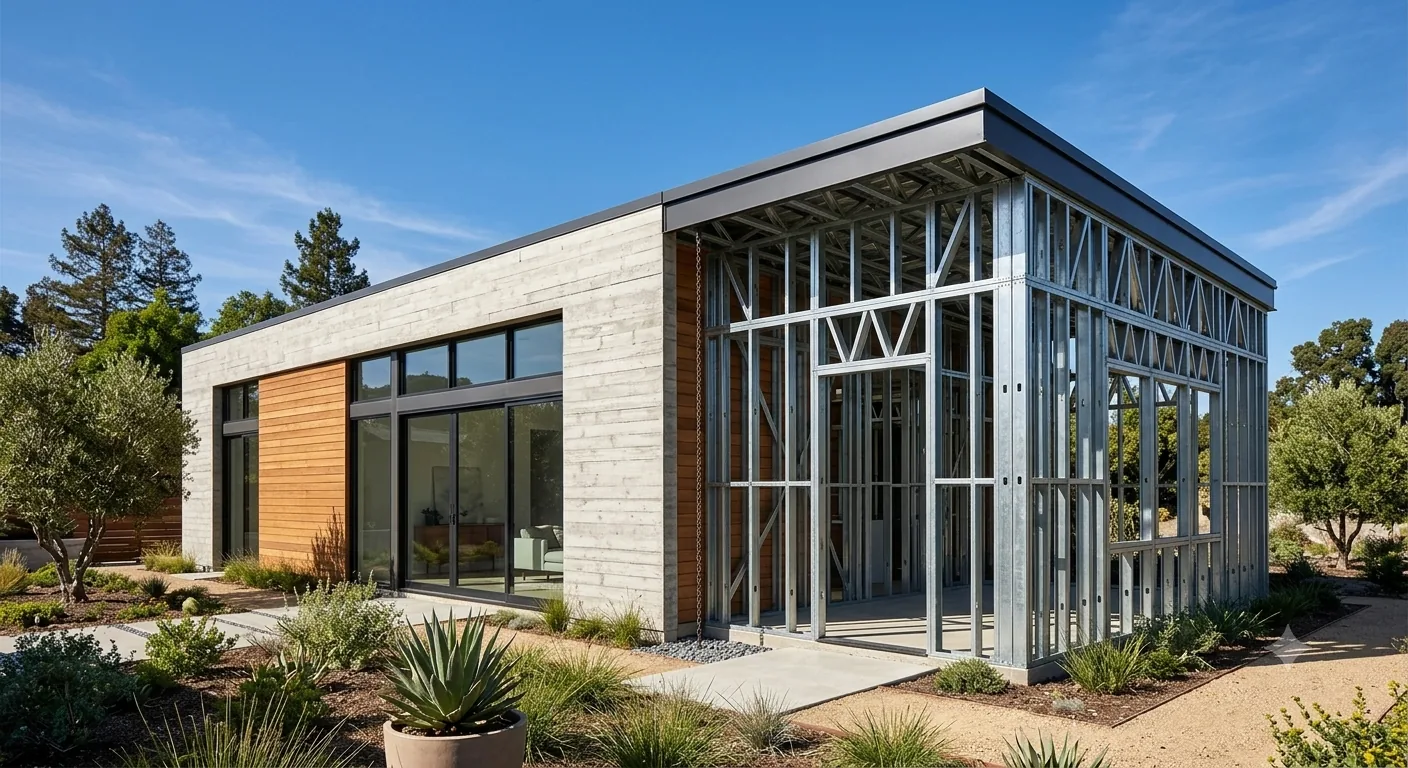
Termites are the quiet structural problem in California residential construction. Fire and earthquake get the headlines. Termites do the slow, cumulative damage that shows up at the home-sale inspection or after a renovation tear-out reveals what's actually behind the drywall.
The UC Integrated Pest Management program identifies California as one of the most termite-pressured states in the country. The California Structural Pest Control Board records active termite activity on a meaningful fraction of wood-frame homes inspected at point of sale. The bills, soil treatments, fumigation tenting, structural repairs, are real, recurring, and almost universally borne by the homeowner.
The structural choice that makes this problem go away is light gauge steel framing. Not "reduces." Eliminates. Termites eat cellulose. Steel contains none. There is nothing for them to consume in the structural envelope.
The short answer: Yes, light gauge steel framing prevents termites at the structural level, because termites eat cellulose and steel contains none. Galvanized cold-formed steel gives subterranean and drywood termites no food source, no nesting cavity, and no entry path, so the structural envelope cannot host a colony. The risk is eliminated, not reduced.
"California has some of the most aggressive termite pressure in the country, and wood framing is the meal. Light gauge steel is not food. There is nothing to tent, nothing to treat, and nothing to repair after the damage is done. You remove the problem instead of managing it for the life of the house."
1. California's two termite species
The first thing to understand is that California's termite problem is two problems, not one. The treatments are different. The risk to the structure is different. And a wood-frame home in coastal California is typically exposed to both.
Subterranean termites (Reticulitermes hesperus)
The western subterranean termite. Lives in soil colonies, sometimes very large (hundreds of thousands of individuals), and accesses buildings through ground contact, foundation cracks, plumbing penetrations, or mud tubes built up the exterior of a foundation wall. They need soil contact and moisture access to survive. Damage is typically silent and progressive, focused on the lower framing (sill plates, rim joists, lower studs) and any structural wood within reach of the soil interface.
Treatment: soil-applied insecticide barriers at construction (most California codes effectively require this on wood-frame), bait stations, and post-construction perimeter treatments. Active compounds include fipronil, imidacloprid, and bifenthrin. Lifespan of treatment: typically 5-10 years before re-application.
Drywood termites (Incisitermes minor and others)
The southern California drywood termite. Lives inside the wood, no soil contact required. Colonies are smaller but distributed, often hundreds of independent infestation points across a single building. Reproductive swarms in late summer find new wood to enter. Drywood termites attack roof framing, upper walls, exposed beams, attic structure, and any exposed wood from the upper envelope downward.
Treatment: fumigation (tenting) with sulfuryl fluoride, or localized treatment with borate or insecticide injection. Whole-house fumigation displaces occupants for 2-4 days, eliminates active colonies but does not prevent reinfestation. Reinfestation rates in southern California are high.
2. Where the pressure is worst
Termite pressure correlates strongly with moisture, temperature, and proximity to soil and vegetation. The highest-pressure California neighborhoods for wood-frame residential construction are:
- Newport Beach and the Newport Coast. Coastal moisture, marine layer, soft-soil foundations, and significant landscaping create the conditions western subterranean termites thrive in. Drywood termites add upper-envelope pressure.
- Laguna Beach and Laguna Niguel. Coastal pressure combined with hillside lots where retaining walls and drainage create constant moisture conduits to wood framing.
- Malibu and the Malibu coast. Identical pressure profile to Newport, with the addition of older wood-frame stock that often lacks modern moisture barriers.
- Pacific Palisades. Pre-2025 Palisades wood-frame homes were under significant drywood termite pressure. The fire eliminated some of the highest-pressure stock; rebuilds in wood will face the same pressure on the next 50-year cycle.
- San Diego County. The state's highest cumulative drywood termite pressure, particularly in coastal La Jolla, Del Mar, Encinitas, and Carlsbad.
- Inland low-elevation valleys with irrigated landscaping (Newport Heights, parts of Irvine, much of the San Gabriel Valley) carry meaningful subterranean termite pressure.
If your project is in any of these zones and being framed in wood, you are entering a multi-decade cost commitment of treatment, monitoring, and eventually repair.
3. The lifetime cost of termite treatment on a wood-frame home
Cost specifics vary by carrier, structure size, infestation severity, and treatment vendor. We describe the cost profile qualitatively here because the actual figures shift constantly with treatment market conditions.
For a typical California coastal luxury wood-frame home over a 22-year ownership period, the cumulative termite-related expense pattern includes:
- Pre-construction soil treatment. A baseline construction-time expense, typically priced per linear foot of foundation perimeter.
- Annual termite inspections. Recurring annual cost, often bundled into broader pest-control contracts.
- Periodic re-treatment. Soil barriers re-applied every 5-10 years. Bait station maintenance ongoing.
- At least one full-house fumigation over a 22-year ownership cycle is typical in high-pressure coastal zones. Fumigation requires displacement (hotel, alternate housing) plus food and medicine bagging, plus the treatment itself.
- Localized structural repair at the point of damage discovery. The repair cost depends on what was eaten, where, and how much load it carried. Sill plate replacement is a substantial structural event.
- Disclosure-driven repair at point of sale. California requires Section 1 (active termite damage) work to be completed before a home sale in most transactions. This is the bill many owners encounter at the time they planned to leave.
The cumulative qualitative position: termite-related expenses on a wood-frame coastal California home over a 22-year ownership cycle are substantial, recurring, and predictable. They are also entirely avoidable with a non-cellulose structural frame.
4. Why galvanized steel is structurally immune
Termites eat cellulose. Cellulose is the structural polysaccharide that makes up the cell walls of wood. Termite digestive systems contain symbiotic gut microorganisms (protists in subterranean termites, bacteria in drywood) that can break cellulose down into usable sugars. This is the only food source termites can use.
Light gauge steel framing is cold-formed from galvanized steel sheet. It contains:
- Carbon steel substrate (iron + small percentages of carbon and other alloying elements)
- A zinc galvanizing coating (typically G60 or G90 for residential framing) protecting the substrate from oxidation
- Zero cellulose, zero organic material, zero food value for termites of any species
The result is structural immunity, not resistance. A galvanized steel stud, joist, top plate, rim board, or truss provides no food source, no nesting cavity, and no entry path for either subterranean or drywood termites. Steel-framed walls cannot host termite colonies at the structural level. The risk is eliminated.
5. Soil treatment vs. structural immunity
This is the comparison most homeowners don't get a clear answer on. Here it is:
| Approach | Steel Framing | Soil + Maintenance Treatment |
|---|---|---|
| Addresses subterranean termites | Yes, structurally | Yes, while treatment is current |
| Addresses drywood termites | Yes, structurally | No, requires fumigation |
| Requires re-application | Never | Every 5-10 years |
| Requires periodic inspection | No structural inspection for termites | Annual inspection standard |
| Risk if treatment is missed | None | Re-infestation, damage |
| Chemical exposure in home | None | Soil and periodic interior treatments |
| Cost trajectory over 22 years | Zero termite-related cost | Recurring, accumulating |
Soil treatment is a maintenance strategy. Steel framing is an elimination strategy. The two are not equivalent. A wood-frame home with diligent soil treatment is better off than one without, but it is still a wood-frame home with an active termite risk profile. A steel-frame home does not have the risk profile to begin with.
6. What still needs attention in a steel-frame home
To stay honest: steel framing eliminates the structural risk. It does not eliminate every cellulose-containing material in the building. Cabinets, baseboards, door trim, hardwood floors, ceiling beams (if real wood is exposed), and wood furniture are all still potential termite food. The difference is what's at stake.
In a wood-frame home, termites eating into a wall stud are destroying load-bearing structure. The repair is structural, expensive, and disruptive. In a steel-frame home, termites eating into a baseboard are destroying a finish material. The repair is to replace the baseboard. The structure is unaffected.
Practical detailing in a steel-frame home:
- Site any exposed wood (architectural beams, ceiling planks, decorative wood) where it can be inspected and replaced without structural disturbance
- Maintain standard pest-control inspections for finish-material exposure (less frequent, simpler scope)
- Detail cabinet kicks, baseboards, and trim with attention to moisture and air-gap conditions
- Use treated or naturally-resistant wood species (cedar, redwood) for any exterior wood elements
None of this is structurally critical. It is finish-level housekeeping in a building whose structural envelope cannot, by material, host termites.
For deeper coverage of how steel-frame's coastal performance compares overall, see our steel vs wood comparison and the steel frame overview. For coastal-specific project pages: Newport Beach, Laguna Beach, Malibu.
Frequently Asked Questions
Are termites really a problem in California construction?
Yes, materially. California has both subterranean termites (Reticulitermes hesperus, the western subterranean) and drywood termites (Incisitermes minor and others). UC Integrated Pest Management identifies California as one of the most termite-pressured states in the country. The California Structural Pest Control Board records termite-related repair activity on a significant fraction of wood-frame homes during ownership transfers. Coastal Orange County, Newport Beach, Laguna, and Malibu carry some of the highest pressure in the state.
What is the difference between subterranean and drywood termites?
Subterranean termites live in soil and enter buildings through ground contact, mud tubes up foundations, or moisture conduits. They are the species most often treated with soil-applied insecticides at the time of construction. Drywood termites live inside the wood itself, typically entering through exposed wood members from the air, no soil contact required. They are treated with fumigation (tenting) or localized chemical injection. California has both. A wood-frame home in coastal California can host both species simultaneously.
Why does light gauge steel frame eliminate termite risk?
Termites eat cellulose. Steel contains zero cellulose. Galvanized cold-formed steel framing provides no food source, no nesting cavity, and no entry path for either subterranean or drywood termites. A steel-framed structural envelope cannot host termite colonies at the framing level. The structural risk is eliminated, not reduced.
What about wood trim, cabinets, and finishes in a steel-frame home? Can termites still attack those?
Yes, finishes that contain cellulose remain food sources. However, the structural risk is what termites destroy homes through, the studs, joists, top plates, and rim boards that hold the building up. A drywood termite eating into a baseboard does not threaten the structure of a steel-framed home, it threatens the baseboard. Replacement is straightforward and contained. The same termite eating into a wood-frame stud is destroying load-bearing structure.
Does soil treatment cover the same risk as steel framing?
No. Soil treatment (typically fipronil, imidacloprid, or bifenthrin applied to soil under and around the foundation) is a chemical barrier against subterranean termites only. It must be reapplied periodically (typically every 5-10 years), it does not address drywood termites at all, and it does not affect the wood-frame structure's vulnerability to termites that enter from above ground. Soil treatment is a maintenance approach. Steel framing is a structural elimination.
Sources & further reading
- University of California Integrated Pest Management (UC IPM), Pest Notes on Subterranean and Drywood Termites (ucanr.edu/sites/IPM)
- California Structural Pest Control Board, Wood-Destroying Pest Inspection Reports (Section 1 / Section 2)
- California Business and Professions Code, Division 3, Chapter 14, Structural Pest Control Board statute
- California Department of Pesticide Regulation, Termiticide and Wood Treatment Active Ingredient Listings
- AISI S100 / S220, North American Specification for the Design of Cold-Formed Steel Structural Members
- ASTM A653, Standard Specification for Steel Sheet, Zinc-Coated (Galvanized) by the Hot-Dip Process
Building a coastal California home? Skip the 22-year termite relationship.
ESRL Development specializes in light gauge steel frame residential construction across coastal LA & Orange County. 22 years of California experience. Free 30-minute consultation, no obligation.
Begin a project ↗