Homeowners in California fire zones are having the same conversation in 2026 that nobody in this state had to have ten years ago: "Can I actually get insurance on this house?"
For wood-frame homes in Pacific Palisades, Malibu, Altadena, Calabasas, Topanga, Bel Air, the OC hillsides, the honest answer is increasingly: not at standard rates, sometimes not at all. Major carriers have pulled back. The FAIR Plan, designed to be the state's last resort, has become first-resort for a meaningful fraction of fire-zone owners. Premiums for what coverage exists have multiplied.
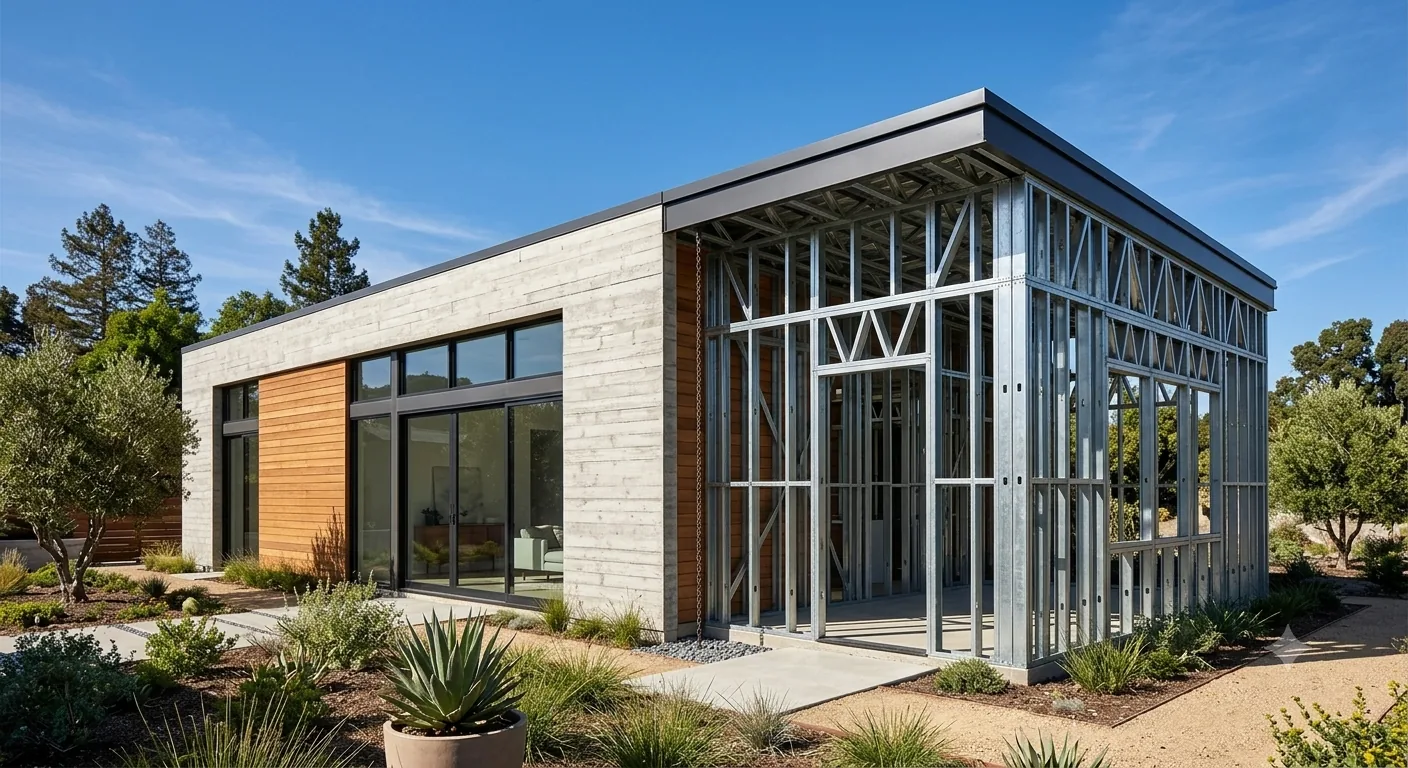
For steel-frame homes, the conversation is different. Not easy, not automatic, but materially different. Non-combustible classification is one of the only structural variables an owner can change that an insurance carrier directly rewards. Many carriers offer a discount for it. More importantly, a growing number of carriers will write a steel-frame fire-zone policy when they will no longer write a wood-frame one in the same zip code.
This article is the 2026 reality, from the contractor side. What changed, what the FAIR Plan actually is, what steel-frame does for your insurance position, and the documentation packet to bring to your broker.
The short answer: Yes, you can usually get homeowners insurance in a California fire zone in 2026, but for wood-frame homes it increasingly means the FAIR Plan plus a DIC wraparound rather than a standard policy. A non-combustible steel-frame home is materially easier to place, because a growing number of carriers will write a steel-frame fire-zone policy when they will no longer write a wood-frame one in the same zip code, and state-required hardening discounts can apply.
"In a California fire zone, insurers are increasingly willing to write a steel-frame home when they will not write a wood-frame one in the same zip code. A non-combustible frame is not only safer, it is more insurable, and hardened construction can earn state wildfire discounts."
1. The 2025-2026 California insurance crisis, in plain English
From 2017 forward, California wildfires generated insured losses that exceeded historical actuarial models by a wide margin. The Camp Fire (2018), the Glass Fire (2020), the Caldor Fire (2021), and the Palisades and Eaton fires (2025) each produced multi-billion dollar payouts. The cumulative effect was that major insurance carriers' California books became loss-positions that they could not sustain at then-regulated premium structures.
The response came in three waves:
- 2022-2023: State Farm, Allstate, Liberty Mutual, and others paused new homeowner applications in fire-exposed California zip codes.
- 2024: Several carriers began aggressive non-renewals at policy anniversaries, particularly for higher-value wood-frame homes in WUI zones.
- 2024-2025: The California Department of Insurance's Sustainable Insurance Strategy began allowing forward-looking catastrophe modeling and reinsurance pass-through in premium filings, gradually opening the standard market back up, but with materially higher pricing.
The net result for a homeowner in 2026 is: more carriers are quoting again, but at higher premiums, with tighter underwriting (defensible space, roof condition, vent type, construction class), and with continued caution on wood-frame structures in the highest-severity zones.
2. Non-renewals and what they actually mean
A non-renewal is not a cancellation. The insurer cannot terminate your policy mid-term for risk reasons. What they can do is decline to renew it at the next anniversary, sending you a notice typically 75 days before expiration.
If you receive one, the practical next steps are:
- Contact your independent broker (not your captive agent) the same week. They can shop the market in days, not weeks.
- Request the carrier's underwriting reason in writing. "Construction class" is the most common reason in fire zones, exactly the lever steel frame addresses.
- If standard-market replacement isn't found, file for the FAIR Plan + DIC wraparound. Don't let the policy lapse for any window.
- Document any home-hardening upgrades (Chapter 7A retrofits, defensible-space improvements, ember-resistant vents, roof replacement) and re-shop the standard market in 12 months. Conditions are improving steadily as the Sustainable Insurance Strategy takes effect.
3. The FAIR Plan, explained
The California FAIR Plan Association is the state's insurer of last resort. It is not a state agency, it is an industry-funded pool that all licensed property insurers participate in. Its purpose is to make basic fire coverage available to property owners who genuinely cannot find it in the standard market.
Key facts:
- Coverage is limited. The FAIR Plan provides a "DP-3" type policy, fire, lightning, internal explosion, and a few additional perils. It does not cover liability, theft, water damage, or many other risks a standard homeowners policy covers.
- Most owners pair it with a DIC policy. A "Difference in Conditions" wraparound policy from a non-admitted carrier fills the gaps. The combination of FAIR Plan + DIC approximates a standard homeowners policy.
- It typically costs more, for less. The combined FAIR Plan + DIC package is usually more expensive than a standard policy would have been at pre-crisis pricing, and the deductibles are higher.
- It is not a permanent destination. Enrollment is reviewed annually. As the standard market reopens, owners can and should re-shop. Steel-frame homes are more likely to make the jump back to the standard market quickly.
The FAIR Plan's caseload tripled between 2020 and 2024. Post-Palisades, enrollment in LA and OC fire zones grew further. The Plan is solvent (it has assessment authority over all participating insurers if losses exceed reserves) but it is widely understood as a stopgap, not a healthy long-term answer for the California market.
4. Why steel-frame homes still get coverage
From an underwriter's perspective, "construction class" is one of the cleanest, most underwritable variables on a residential application. The carrier doesn't have to inspect, doesn't have to interpret. The structural type is documented in permits, in plans, and in the certificate of occupancy.
Non-combustible construction (light gauge steel frame qualifies) means:
- The structural frame cannot contribute to a fire's spread or intensity.
- Total-loss probability in a wildfire is materially lower than for an equivalent wood-frame home.
- Partial-loss claim frequency is lower across the board, no termite damage, no mold remediation, less roof damage from windstorms.
- Replacement cost estimates are more predictable.
For an underwriter pricing a fire-zone risk, those four facts translate into a written-policy decision more often than not. A growing number of California carriers will write a steel-frame home in a Very High FHSZ where they would non-renew or decline a wood-frame home in the same address.
5. What carriers actually reward
Beyond the construction-class decision, here is what carriers actually credit in 2026 California fire-zone underwriting:
- Non-combustible structural frame (steel), state-required hardening discounts, with significant variation by carrier.
- Class A roof covering (tile, metal, certain composition), standard discount, several carriers credit it as a separate line.
- Ember- and flame-resistant vents (Vulcan, Brandguard, O'Hagin), credited by most fire-zone-friendly carriers.
- Documented defensible space (Zone 0/1/2 per Cal. Pub. Res. Code §4291), increasingly required, not just credited.
- Recent roof replacement (within 10-15 years, with Class A material), improves underwriting acceptance.
- Indoor sprinkler system, credit varies, helpful in some fire zones.
- Hardened exterior cladding (stucco, fiber cement, masonry), increasingly material.
- AB 38 disclosure documentation on file, required for sale, helpful at any underwriting touchpoint.
The compounding effect matters. A steel-frame home with a Class A tile roof, ember-resistant vents, and documented defensible space stacks four positive underwriting factors. It is the kind of application that gets quoted in the standard market when the lot next door (same zip, same fire severity, wood-frame, untested vents) goes to the FAIR Plan.
6. How to present a steel-frame home to your insurer
Most insurance applications ask one question about construction: "frame, masonry, or steel?" A homeowner who checks the right box, hands over a few documents, and works with a broker who knows the non-combustible-friendly carriers will get a meaningfully different result than one who doesn't.
Step 1: Work with an independent broker, not a captive agent.
An independent broker can quote across 20-50 carriers. A captive agent (State Farm, Allstate, Farmers) is bound to one. In a tight market, the breadth matters.
Step 2: Lead with construction type.
On the application, in the cover email, in the underwriter call, identify the home as light gauge steel frame, non-combustible Type IIB / V-A construction. Don't bury it in the documentation.
Step 3: Provide the documentation packet up front.
Don't wait for the carrier to ask. A complete packet at submission speeds the quote and shortens the underwriting back-and-forth. The next section lays out the packet.
Step 4: Ask for the non-combustible discount in writing.
Carriers vary. Some apply it automatically; some require a written request and supporting documentation. Ask the broker to confirm the discount is reflected in the quote, on paper.
Step 5: Renew documentation annually.
At renewal, refresh the defensible-space documentation, refresh the roof condition photos, and reconfirm vent products. Underwriters re-examine fire-zone policies more frequently than non-fire-zone policies.
7. The documentation packet
This is the packet ESRL prepares for every steel-frame home at substantial completion. Bring it to your insurer in this order:
- Structural specification letter, one-page signed letter from the structural engineer of record confirming the home is framed in cold-formed (light gauge) steel per AISI S100 / S220, with stud gauge and connection schedule referenced.
- ICC-ES evaluation reports, code-compliance reports for the specific steel framing products used. One-page summary plus links.
- Chapter 7A compliance letter, signed letter from the architect or contractor of record attesting to Chapter 7A assembly compliance, with each section addressed (roof, walls, eaves, vents, decks, windows).
- Stamped structural drawings, full set, or relevant sheets showing framing plan and connection details.
- Framing photographs, date-stamped photographs of the steel frame prior to drywall, showing studs, joists, trusses, and the typical wall section.
- Class A roof certification, manufacturer documentation of the Class A fire-rated roof covering installed.
- Vent product schedule, listing of all installed ember- and flame-resistant vents with ICC-ES or OSFM listing numbers.
- Defensible space documentation, AB 38-form-compatible record of Zone 0/1/2 conditions, ideally with date-stamped photographs.
- Certificate of occupancy, final from the local building department.
This packet is what ESRL provides at the end of every project. We've found that owners who walk into the renewal conversation with this packet on paper, rather than verbally describing the home, get materially better quotes. For a deeper service walk-through, see our insurance savings guide and our wildfire rebuild page.
Frequently Asked Questions
Why is California homeowners insurance so hard to get in 2026?
Between 2022 and 2025, major California carriers (State Farm, Allstate, AIG, Liberty Mutual, Farmers) paused new policies, declined renewals, or exited the state outright. The losses from the 2017 Tubbs, 2018 Camp, 2020 Glass, 2021 Caldor, and 2025 Palisades and Eaton fires exceeded what carrier reserves could sustain at then-current premium structures. The 2024 California Sustainable Insurance Strategy began correcting the regulatory bottleneck, but supply remains tight and premiums materially higher than pre-crisis levels.
What is the California FAIR Plan?
The California FAIR Plan is the state's insurer of last resort. It is funded by all licensed property insurers operating in California and provides basic fire coverage to homeowners who cannot obtain coverage in the standard market. FAIR Plan coverage is more limited than standard homeowners insurance (it covers fire and limited additional perils, not the full HO-3 package) and typically costs more for less coverage. A wraparound DIC policy is usually paired with FAIR Plan to fill the gaps.
Do steel-frame homes get cheaper insurance in California?
Often yes, particularly in fire zones. Under California's Safer from Wildfires regulation, carriers are required to offer wildfire hardening discounts; the discount amount is set by each carrier, and a hardened, non-combustible home qualifies for several of the listed measures. The discount must be applied for, requires documentation, and varies by carrier. Steel-frame homes are also more frequently accepted in the standard market when wood-frame homes in the same zip code are non-renewed.
What documentation do I need to give my insurer to prove steel-frame construction?
Insurers typically want: (1) the AISI S100 / S220 structural specification confirming light gauge steel, (2) ICC-ES evaluation reports for the structural products used, (3) a Chapter 7A compliance letter signed by the architect or contractor of record, (4) the engineer of record's stamped structural drawings, and (5) photographs of framing prior to drywall. ESRL provides this packet at substantial completion for every project.
Will switching to steel guarantee I can get insurance?
No. Insurance decisions are made carrier-by-carrier and account for many factors beyond construction type: zip code, defensible space, proximity to brush, building age, claims history, and the carrier's current capacity in your area. Steel-frame construction materially improves your case but does not guarantee acceptance. Working with an independent broker who knows the non-combustible-friendly carriers is the practical next step.
Is the FAIR Plan acceptable for a mortgage?
Most California lenders will accept a FAIR Plan policy plus a Difference in Conditions (DIC) wraparound policy as a combined package. However, terms vary by lender and loan type. If you are buying or refinancing, confirm acceptable coverage forms with the lender's insurance department before closing. A steel-frame home is more likely to be placed in the standard market, simplifying the lender conversation.
Sources & further reading
- California Department of Insurance, Sustainable Insurance Strategy (2024-2026 rollout)
- California FAIR Plan Association, Annual Reports and Coverage Forms (DP-3)
- California Assembly Bill 38 (2019), codified at Gov. Code §51182 and §51189
- California Public Resources Code §4291, Defensible Space Requirements (SRA)
- California Building Code (CBC) Chapter 7A, §707A.1 through §707A.10
- ICC-ES Evaluation Reports, Light Gauge Steel Framing Code-Compliance Listings
- AISI S100 / S220, North American Specification for the Design of Cold-Formed Steel Structural Members and Cold-Formed Steel Light-Frame Construction
- Insurance Information Institute, California Homeowners Market Reports (2024-2026)
Considering a steel-frame build in a California fire zone?
ESRL Development hands every owner a complete steel-frame insurance documentation packet at substantial completion. 22 years of California experience. Free 30-minute consultation, no obligation.
Begin a project ↗