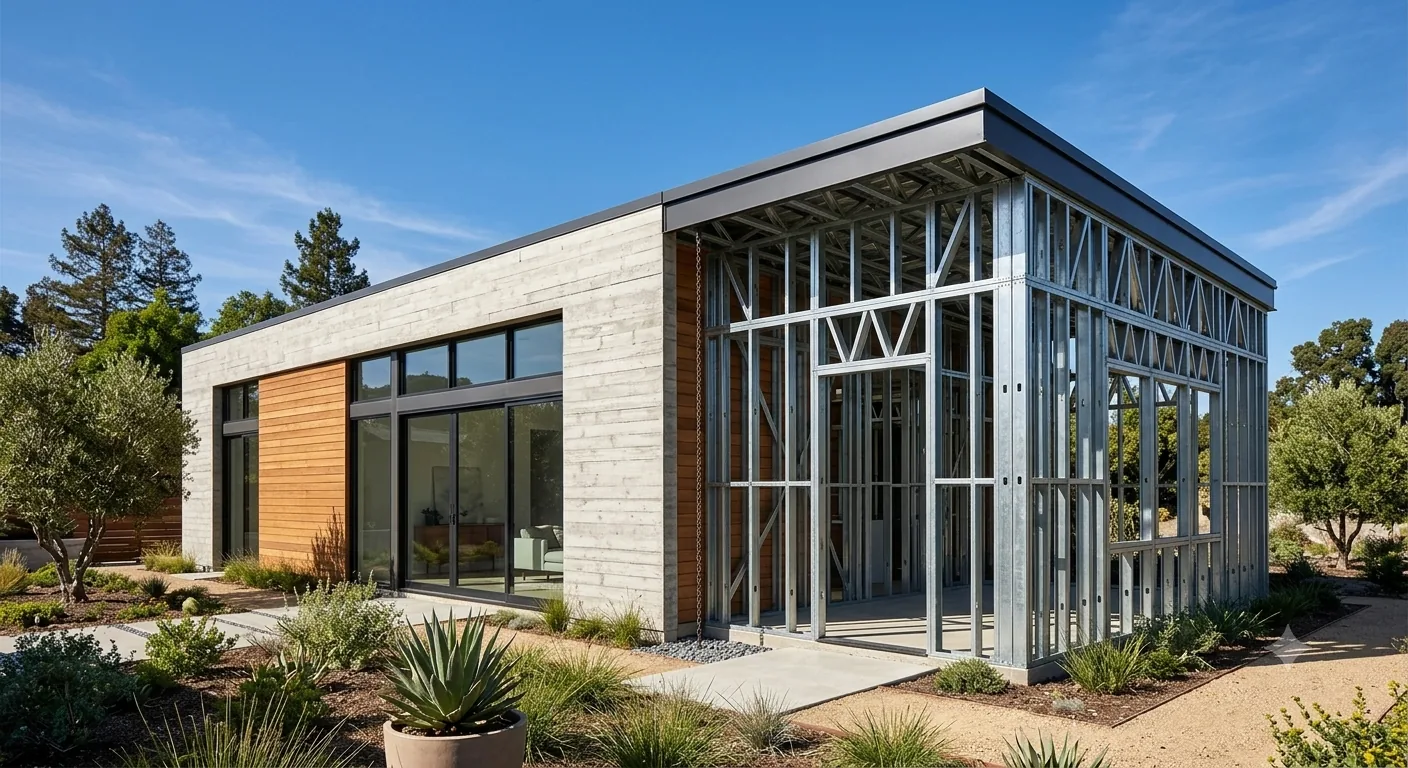
If you are reading this because you lost a home in the Palisades Fire, what follows is not a sales pitch. It is the same conversation we have on the kitchen table with every Palisades owner who calls us. The structural decision in front of you matters, and there is a real, defensible answer.
We will keep this short, accurate, and useful.
The Palisades Fire of January 2025 burned more than 23,000 acres and destroyed thousands of structures across the Palisades, Malibu, and Topanga corridor. Nearly all the homes that burned were wood-frame. Many were built to current California code. Some had been retrofitted under earlier Chapter 7A updates. The fire took them anyway.
The reason is structural, not behavioral. Embers, radiant heat, and direct flame all eventually find the fuel that's there. A wood-frame home in a Wildland-Urban Interface zone has the fuel built into the walls. Chapter 7A retrofits buy you time and improve odds, but they do not change what the structural frame is made of.
This article is the case for changing that, on the rebuild.
The short answer: Pacific Palisades rebuilds should use light gauge steel frame because the structural frame is the largest fuel category in a wood-frame home, and steel is non-combustible. Steel is non-combustible while wood ignites near 500°F, so removing the wood frame addresses the exact failure mode of an ember event that overwhelms the exterior envelope. Because every Palisades rebuild is now built to current code with Chapter 7A mandatory, a non-combustible steel frame also simplifies compliance, helps with fire-zone insurability, and builds faster.
"On a Palisades rebuild, the wood frame is the single largest fuel category in the house. Light gauge steel is non-combustible and does not ignite or feed a fire, where wood ignites near 500. Rebuilding the frame in steel removes the exact thing that burned last time."
- Why code-compliant homes still burned in 2025
- What changed in LA's 2026 rebuild process
- The case for steel frame, plainly
- Schedule, move-in, and the real cost of waiting
- Insurance is harder, steel frame helps
- Defensible space, and what it really means
- What to look for in a Palisades rebuild contractor
- FAQ
1. Why code-compliant homes still burned in 2025
This is the question most Palisades owners are still asking. The short answer is that "code-compliant" in California means meeting the prevailing code at the time of permit. For many Palisades homes built before 2008, that means there was no Chapter 7A requirement at all. Homes built between 2008 and the 2019 update were built to earlier, less stringent versions of the chapter.
Even homes built fully to current Chapter 7A had a structural frame that was, in most cases, still wood. Chapter 7A governs assemblies and finishes (roof, walls, eaves, vents, decks, windows). It does not require non-combustible structural framing. So a "fully Chapter 7A-compliant" wood-frame home is still a wood-framed home with ignition-resistant exterior layers wrapped around a combustible skeleton.
In a high-intensity ember event, ignition-resistant exterior layers buy meaningful time. In the kind of multi-front ember storm that crossed the Palisades on January 7-8, 2025, exterior layers that held for hours eventually failed at vents, eaves, deck transitions, or window-glazing intrusions. Once the fire reached the structural frame, the frame was the fuel.
2. What changed in LA's 2026 rebuild process
The City of Los Angeles and LA County DPW implemented an expedited rebuild track for fire victims beginning in spring 2025 and extended through 2026. The relevant changes for homeowners:
- Like-for-like rebuilds (same footprint, same height, same general envelope as the destroyed structure) bypass design review and zoning conformance review. Plan check is fast-tracked through a dedicated team.
- Code compliance still applies. Current CBC, Chapter 7A, Title 24, and seismic provisions are required regardless of whether the original home complied.
- Certain permit and plan-check fees are waived for fire victims with valid claim documentation.
- Substantial modifications (different footprint, height changes, added square footage) still go through expedited intake but are subject to design review at a streamlined cadence.
- HPOZ scrutiny on like-for-like rebuilds is materially relaxed.
The practical implication: every Palisades rebuild is being built to current code, which means Chapter 7A is mandatory. As we covered in the Chapter 7A article, every assembly in the home now has to meet ignition-resistance requirements. Steel frame doesn't change that, but it makes plan-check on the structural side simpler, removes the largest fuel category from the building, and reduces inspection friction across the Chapter 7A items.
3. The case for steel frame, plainly
Here is the case, point by point, in the language a Palisades owner needs:
Steel doesn't burn.
The structural frame is the largest fuel category in a wood-frame home. Removing it is the most impactful single structural decision you can make on a fire-zone rebuild. Steel is non-combustible. Wood ignites at roughly 500°F.
Chapter 7A is automatic on the structure.
The ignition-resistance requirements of Chapter 7A apply to assemblies. Steel framing makes assembly compliance simpler at every interface, eaves, walls, deck-to-wall transitions, soffit details, because the structure behind the assembly is already non-combustible.
Insurance is harder, steel frame helps.
Major California carriers are non-renewing wood-frame fire-zone policies. Several are still writing non-combustible policies in the same zip codes. Hardened, non-combustible construction earns the wildfire discounts California regulation requires carriers to offer. The full picture is in our insurance article.
The build is faster.
Panelized steel framing erects in approximately one day for a 2,000 SF footprint. Every subsequent trade phase starts sooner. On a 12-18 month custom-home schedule, total completion typically compresses by 4-6 weeks. For owners paying construction-loan interest and rent or temporary housing simultaneously, that compression is material.
The home doesn't move.
Steel doesn't warp, shrink, or expand seasonally. Drywall doesn't crack. Doors stay square. Floor squeaks don't develop in year three. For a luxury custom home with high-end finishes, the long-term experience of living inside the structure is materially different.
Termites and mold don't exist for the frame.
Coastal pressure on wood framing is real, particularly in Pacific Palisades' marine layer climate. Steel is inorganic. Termites cannot eat it. Mold has no substrate to grow on. Two of the most common 22-year ownership costs are eliminated structurally.
4. Schedule, move-in, and the real cost of waiting
For Palisades families, the schedule conversation is not abstract. Most owners are paying rent on a temporary residence (LA temporary rentals in the surrounding neighborhoods are not inexpensive), construction-loan interest, and the ongoing carrying cost on the lot. Every month the rebuild is in construction is a month with two cost centers running.
Steel frame's schedule advantage is the structural shell. The whole frame, walls, floors, roof trusses, can be erected in a few days on a panelized package. The remaining trades, MEP, drywall, finishes, landscape, are similar to a wood build. But because the structural shell is earlier, every downstream trade starts earlier. The compounding effect is what produces the 4-6 week earlier completion we typically see.
On a luxury custom Palisades rebuild, the carrying-cost savings from earlier completion alone often offset the framing-line premium for steel. The structural decision pays back at the move-in date.
5. Insurance is harder, steel frame helps
This is the section that most Palisades owners are most worried about, with reason. Many carriers will not write new homeowner policies in the Palisades fire zone at all. Some carriers will write non-combustible construction in zones where they will not write wood-frame. The FAIR Plan is enrolled at record levels.
For a steel-frame rebuild, the path to standard-market coverage is materially easier:
- Independent brokers can quote across non-combustible-friendly carriers (Chubb, Cincinnati, certain admitted markets, and several non-admitted excess and surplus carriers).
- The ESRL documentation packet (structural specs, ICC-ES reports, Chapter 7A compliance letter) compresses the underwriting back-and-forth from weeks to days.
- Even when FAIR Plan is the initial placement, a steel-frame home is more likely to move back to the standard market at the next renewal cycle.
Coverage is never guaranteed by construction type alone. But non-combustible classification is one of the few variables an owner controls that materially shifts the underwriting decision.
6. Defensible space, and what it really means
Chapter 7A handles the building. Defensible space handles the landscape. For Palisades rebuilds, the defensible-space requirements are not optional and are tied to certificate of occupancy:
- Zone 0 (0-5 ft from the structure): Ember-resistant. No combustible mulch, no flammable plants, no wood fencing attached to the building, no stored combustibles. Hardscape, gravel, or fire-safe stone is the default.
- Zone 1 (5-30 ft): Lean, clean, and irrigated. Plants spaced to prevent fire spread, ground-covers managed, fuel removed.
- Zone 2 (30-100 ft): Reduced fuel. Brush thinned, tree limbs above ground separated from understory.
For lots adjacent to brush or open hillside, defensible-space management is an ongoing maintenance commitment. The 100-foot perimeter extends across property lines in many Palisades lots, which means coordination with neighboring owners. We help every ESRL Palisades client think through this at the schematic-design stage, not after.
7. What to look for in a Palisades rebuild contractor
Practical due diligence, in the order it matters:
- California GC license. Verify at CSLB.ca.gov. Confirm the license is active, in good standing, and held in the company name on the contract.
- Demonstrated Chapter 7A experience. Not "we can do it." Ask for specific previous projects, plan-check experience, and inspector relationships.
- Hands-on steel-frame experience. Most LA GCs subcontract steel framing to a specialty crew if they accept it at all. Ask which projects the owner personally supervised in steel frame, and which mill or panel shop they sourced from.
- LADBS / LA County DPW expedited rebuild familiarity. The expedited rebuild process has specific intake protocols and dedicated plan-check teams. A contractor who has run multiple files through the post-Palisades process navigates faster.
- Owner accountability. A owner-led project, where the company owner is on-site, answering the phone, and making the decisions, is materially different from a project handed to a junior PM. For a rebuild of the home you'll likely live in for the rest of your life, this matters.
ESRL's full Pacific Palisades service page is here, and our broader wildfire rebuild service page walks through every project phase.
Frequently Asked Questions
Why did Pacific Palisades homes that were built to code still burn in 2025?
Most Palisades homes were built before California's Chapter 7A WUI code took full effect (2008 and tightened in every cycle since). Even newer homes that were technically code-compliant carried Chapter 7A retrofits applied to wood-frame structures, the frame itself was still combustible. The January 2025 fire's ember pressure and radiant heat overwhelmed wood-frame envelopes that were never structurally non-combustible to begin with.
What changed in Pacific Palisades' rebuild process after the 2025 fire?
LA County and the City of Los Angeles implemented an expedited rebuild track for Palisades fire victims: pre-approved like-for-like rebuilds bypass traditional design review and HPOZ scrutiny, plan-check is fast-tracked through a dedicated team, and certain permit fees are waived. Owners rebuilding outside the like-for-like envelope still benefit from streamlined intake. The expedited process is conditional on Chapter 7A compliance and current code, which is where steel frame becomes the more direct path.
Is steel frame faster than wood for a Palisades rebuild?
Typically yes, by several weeks. Steel framing is panelized off-site and erected on-site in approximately one day for a 2,000 SF footprint, versus 1-2 weeks for stick-built wood. The compounding effect through MEP, drywall, and finish trades typically translates to 4-6 weeks earlier completion on a 12-18 month custom home. For owners paying construction-loan interest and rent simultaneously, that compression is material.
Will my insurance be different if I rebuild in steel versus wood?
In the Palisades fire zone, very likely yes. Multiple major California carriers will write a steel-frame fire-zone policy when they will not write a wood-frame one. Hardened, non-combustible construction earns the wildfire discounts California regulation requires carriers to offer. We outline the full underwriting picture in our companion article on California fire-zone insurance.
What should I look for in a Palisades rebuild contractor?
Five practical things: (1) a California GC license (verify at CSLB.ca.gov), (2) demonstrated Chapter 7A compliance experience, (3) hands-on light gauge steel frame experience (most LA GCs subcontract this, ask to see completed projects), (4) familiarity with LADBS or LA County DPW expedited rebuild intake, and (5) a owner who is personally accountable on the project rather than a project manager handed the file.
Sources & further reading
- CalFire 2025 Palisades Fire Incident Report and Preliminary Damage Assessment
- City of Los Angeles Department of Building and Safety (LADBS), Palisades Fire Rebuild Resource Center
- LA County Department of Public Works, Eaton/Palisades Expedited Rebuild Program
- California Building Code (CBC) Chapter 7A, §707A.1 through §707A.10
- California Public Resources Code §4291, Defensible Space (SRA)
- California Assembly Bill 38 (2019), Home Hardening and Defensible Space Disclosure
- California Department of Insurance, Sustainable Insurance Strategy (2024-2026)
- AISI S100 / S220, Cold-Formed Steel Structural Design Standards
Rebuilding in the Palisades fire zone?
ESRL Development specializes in Chapter 7A-compliant light gauge steel frame fire-rebuild construction. 22 years of California experience, owner-led from first conversation to certificate of occupancy. Free 30-minute consultation, no obligation.
Begin a project ↗