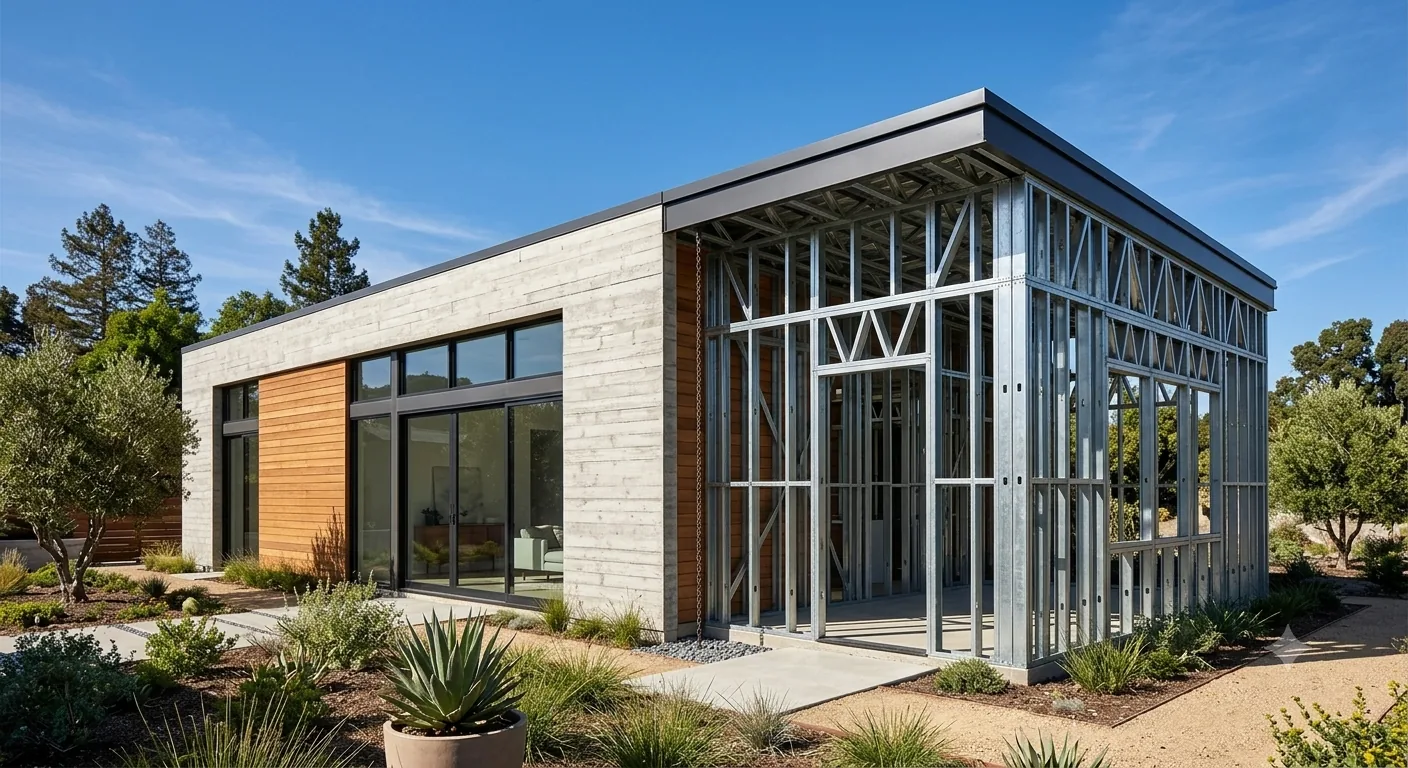
The Eaton Fire took much of Altadena in January 2025. Now the rebuild is underway, and every homeowner who lost a house faces the same decision most people only get once: what to build the new home out of.
Almost every home that burned was wood frame. Many of the homes going back up are wood frame again. That is the decision worth pausing on, because the structural frame is the largest fuel category in a house, and rebuilding it in wood puts the same material back in the same Very High Fire Hazard Severity Zone. This guide is the working contractor's case for rebuilding in light gauge steel frame, and what it changes for code, insurance, and schedule.
The short answer: Altadena rebuilds should strongly consider light gauge steel frame because the structural frame is the largest fuel category in a wood-frame home, and steel is non-combustible. Steel is non-combustible while wood ignites near 500, so rebuilding the frame in steel removes the exact material that carried the last fire. Because every rebuild is now built to current code with Chapter 7A mandatory, a non-combustible frame also simplifies compliance and helps with fire-zone insurability.
"A rebuild is the one time you get to change the answer. The wood frame was the largest fuel category in the house that burned. Light gauge steel is non-combustible and does not ignite or feed a fire, where wood ignites near 500. Rebuilding the frame in steel removes the exact thing that carried the last fire."
1. Why the frame is the whole decision
When a house in an ember event fails, it usually fails from the inside out. Embers find a vent, an eave, a gap in the envelope, and once they reach the wood structure, the frame becomes the fuel. Hardening the outside of the house matters, and code now requires it, but the largest single mass of combustible material in a wood home is the frame itself.
Rebuilding that frame in light gauge steel removes that fuel. Steel is non-combustible. It does not ignite, it does not feed a fire, and it holds its structural strength far past the temperature at which wood is already gone. On a rebuild, where you are starting from the foundation anyway, the marginal decision to build the structure in steel is the highest-leverage choice you can make for the next fire.
2. Steel vs wood for a rebuild
| Factor | Light Gauge Steel Frame | Wood Frame |
|---|---|---|
| Fire | Non-combustible | Combustible, ignites near 500°F, becomes the fuel |
| Chapter 7A structural core | Satisfies non-combustible requirement at the frame | Requires added protection, still combustible |
| Seismic | Ductile, shake-table tested at high seismic demand | Code-minimum, racks under repeated load |
| Termites and mold | Immune to both | Susceptible, recurring treatment |
| Insurability (fire zone) | Stronger, non-combustible classification | Increasingly hard to place in WUI zones |
| Speed of shell | Panels erect in about a day | 1 to 2 weeks to frame |
For the full structural breakdown, see Light Gauge Steel Frame vs Wood Frame and the Steel Frame overview.
3. Chapter 7A is now mandatory on Altadena rebuilds
Altadena sits in Los Angeles County's Very High Fire Hazard Severity Zones. Every rebuild is built to current code, which means California Building Code Chapter 7A applies. Chapter 7A hardens the exterior envelope:
- Ignition-resistant or non-combustible siding and exterior walls
- Ember-resistant vents
- Tempered or multi-pane glazing
- Enclosed, protected eaves and soffits
- Class A roof assemblies
Chapter 7A hardens the outside. A steel frame hardens the structure underneath it. Meeting code on the envelope and building the frame in non-combustible steel is the belt-and-suspenders approach to a fire-zone rebuild. For the assembly-by-assembly walkthrough, see our Chapter 7A guide.
4. Insurability after the Eaton Fire
The hardest part of rebuilding in a fire zone is often not the construction. It is keeping the home insurable. Carriers have pulled back from wood-frame coverage in California's fire zones, and a wood rebuild puts combustible material right back on the parcel. A non-combustible steel-frame home is materially easier to place.
- More insurable. A non-combustible structure supports coverage where a combustible one increasingly does not.
- Possible hardening discounts. California requires carriers to recognize wildfire hardening, and non-combustible, hardened construction may qualify for discounts, depending on the carrier and the property.
- Fewer claims over time. Steel is termite-proof and mold-proof, which removes two common maintenance and claim drivers.
ESRL never promises a specific dollar saving or a guaranteed premium; insurance outcomes depend on your carrier and your parcel. The provable point is simpler: steel does not add the fire risk a wood rebuild does. For the full picture, see Homeowners Insurance in California Fire Zones.
5. One contract, start to finish
A rebuild fails most often at the seams: the engineer, the steel supplier, the erector, and the general contractor pointing at each other while your insurance clock runs. ESRL closes those seams. We build under a single contract: a licensed structural engineer engineers the structure, we supply the steel and install it with our own trained crew, then carry the project through finishes and final inspection. One point of accountability, one schedule, one number to call.
6. A realistic rebuild timeline
Steel-frame rebuild, typical sequence
- Phase 1 Site and insurance. Debris removal, lot survey, confirm Chapter 7A scope, coordinate with your insurer on the rebuild scope and documentation.
- Phase 2 Design. Architect or designer sets the new home; ESRL coordinates the steel structure early so it is not an afterthought.
- Phase 3 Construction documents. Full structural (cold-formed steel to AISI S220), MEP, Title 24 energy, and Chapter 7A compliance.
- Phase 4 Plan check and permit. Submittal to LA County or the local building department; clean submittals move faster.
- Phase 5 Build. Foundation, then the panelized steel shell (erected in about a day), then MEP rough, exterior, and finishes.
- Phase 6 Final inspection and Certificate of Occupancy. A well-built steel frame inspects cleanly.
The steel frame is the part of the schedule that compresses. The panelized shell goes up in about a day versus one to two weeks for wood, and every trade after it starts sooner.
7. How to start
The best first step is a conversation before the design is locked, so the steel structure is designed in rather than bolted on. ESRL is a California-licensed general contractor (License #1149234) with 22 years building in the state, and we serve the Altadena and greater Los Angeles rebuild area. See our Pasadena and San Gabriel Valley service area, or read the parallel case for the coast in Why Pacific Palisades Rebuilds Need Steel Frame.
Frequently Asked Questions
Should I rebuild my Altadena home in steel frame after the Eaton Fire?
For a fire-zone rebuild, steel frame is the strongest structural choice. The wood frame is the largest fuel category in a burned home, and light gauge steel is non-combustible, non-combustible, so it does not ignite or feed a fire, while wood ignites near 500 degrees Fahrenheit. Because every Altadena rebuild is now built to current code with Chapter 7A mandatory, a non-combustible steel frame satisfies the structural requirement at the core of the house, is more insurable in a Very High Fire Hazard Severity Zone, and builds faster with pre-engineered panels.
Does Chapter 7A apply to Altadena rebuilds?
Yes. Altadena sits in Los Angeles County's Very High Fire Hazard Severity Zones, so rebuilds are built to current code with California Building Code Chapter 7A mandatory. Chapter 7A hardens the exterior envelope: ignition-resistant siding, ember-resistant vents, tempered or multi-pane glazing, enclosed eaves, and Class A roofing. A non-combustible steel structure complements Chapter 7A by hardening the frame underneath the envelope.
Is a steel-frame rebuild more expensive than wood?
At the framing line, light gauge steel carries a modest premium over wood. Over the life of the rebuilt home, steel is immune to termites and mold, does not warp or rot, and is more insurable in a fire zone, where hardened, non-combustible construction may qualify for California wildfire discounts. We do not publish rebuild prices because material markets move; a free pre-construction consultation provides a project-specific budget you can take to your insurer and lender.
How long does a steel-frame rebuild take in Altadena?
Timelines depend on debris removal, the permit path, and lot conditions, but a steel-frame rebuild compresses the structural phase: a panelized shell erects in about a day versus one to two weeks for wood, and every trade after it starts sooner. Plan on a design and permit phase followed by construction; ESRL builds under one contract, engineering, supplying, and installing the steel to keep the schedule tight.
Can one company handle my whole Altadena rebuild?
Yes. ESRL Development builds under a single contract: a licensed structural engineer engineers the structure, we supply the steel and install it with our own trained crew, then carry the project through finishes and final inspection. One point of accountability matters on a rebuild, where insurance timelines, permits, and multiple trades otherwise create finger-pointing.
Sources & further reading
- California Building Code (CBC) Chapter 7A, Materials and Construction Methods for Exterior Wildfire Exposure
- CAL FIRE, Fire Hazard Severity Zone maps (Los Angeles County)
- Los Angeles County Department of Regional Planning and Building and Safety, rebuild resources
- California Department of Insurance, wildfire hardening (Safer from Wildfires) discount framework
- California Title 24, Part 6, Energy Efficiency Standards
- AISI S220, North American Standard for Cold-Formed Steel Framing
Rebuilding in Altadena?
ESRL Development builds non-combustible light gauge steel frame homes and wildfire rebuilds across LA, including the Altadena and Eaton Fire area, one contract from engineering through final inspection. 22 years of California experience. CA License #1149234. Book a free, no-obligation consultation.
Book a consultation ↗