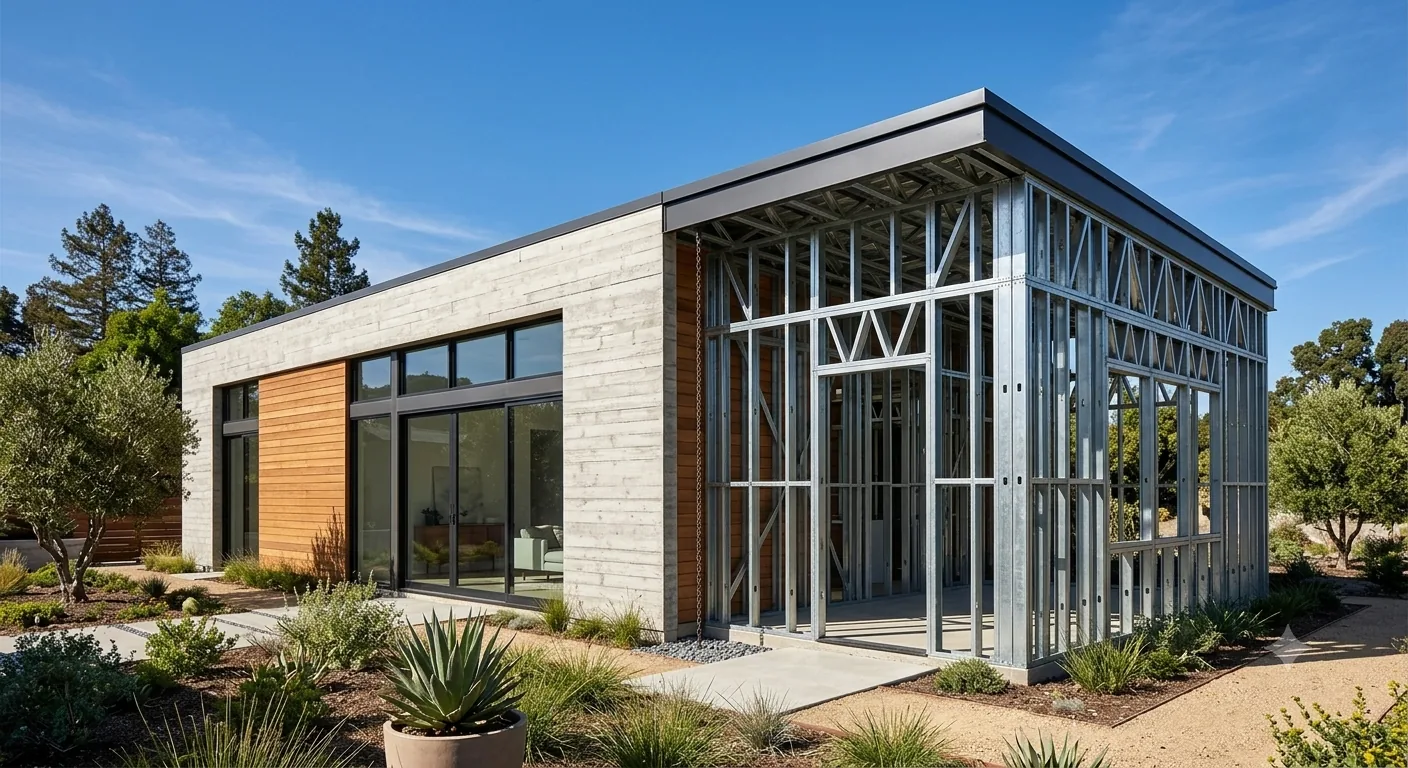
I get asked for a number, and I understand why. But a builder who hands you a flat "it lasts X years" is either guessing or writing a warranty they have not thought through. The useful answer is about what actually ages a frame, so here is how steel really behaves over time.
A well-built light gauge steel frame lasts as long as the building it holds up. Galvanized steel kept dry inside the wall assembly does not rot, does not feed termites, and does not grow mold, so it never starts the decay clock that slowly ages a wood house. The one thing that ages steel is corrosion, and that is controlled by the galvanized coating and by detailing that keeps the framing dry. Steel framing industry sources reference service lives well beyond a typical mortgage. What matters more than any single number is that steel simply does not have wood's failure modes.
"Wood starts dying the day you install it. Moisture, bugs, movement. Steel does not do any of that. The only thing that ages galvanized steel is corrosion, and you control corrosion with the zinc coating and by keeping it dry. Build it right and the frame outlives the mortgage, the finishes, and probably the owner."
1. What actually ends a frame's life
A house rarely fails because the structural material wore out from use. It fails because something degrades the frame over time. In a wood house, the culprits are consistent: water gets into the wood and it rots, termites and other insects eat it, mold and fungus grow in it, and the wood shrinks, swells, and moves with every season. Each of those is a clock, ticking from the day the frame goes up. Good maintenance slows the clocks. Nothing stops them.
2. Why steel has no decay clock
Light gauge steel does not participate in any of those failure modes. Water does not soak into it and rot it. Termites and carpenter ants have nothing to eat. Mold and fungus have nothing to feed on. And steel does not shrink, swell, or warp with humidity, so it does not loosen connections or crack finishes the way seasonal wood movement does. Remove rot, insects, and movement, and you have removed the reasons most wood frames age. That is the core of the durability story, and it is covered further in why steel frame eliminates the termite problem.
| Aging mechanism | Steel Frame | Wood Frame |
|---|---|---|
| Rot from moisture | Does not rot | Rots when it stays wet |
| Termites and insects | Not food | A food source |
| Mold and fungus | Not a host | Hosts both in moisture |
| Seasonal movement | Dimensionally stable | Shrinks, swells, warps |
| Main aging path | Corrosion, controlled by galvanizing | Multiple, always active |
3. The one thing that ages steel: corrosion
Steel has exactly one degradation path that matters in a house: corrosion. Left bare and wet, steel rusts. That is why structural light gauge framing is never bare. It is galvanized, coated in zinc (commonly specified as G60 or G90), and the zinc protects the steel underneath. Inside a dry, conditioned wall, that coating protects the framing for a very long service life. Corrosion only becomes a real risk where steel is left exposed to persistent moisture or is poorly detailed, which is a construction problem, not a material one.
4. How a good builder makes steel last
Steel earns its long service life only if it is built correctly, which is why the contractor matters as much as the material. The things a good steel builder controls:
- Galvanization spec. Specifying the right zinc coating for the application, not the thinnest available.
- Moisture control. Flashing, drainage, and envelope detailing that keep the framing dry.
- No trapped water. Assemblies designed so condensation and any incidental water can escape rather than sit against steel.
- Clean connections. Proper fasteners and coatings at connections, where corrosion would otherwise start.
None of that is exotic. It is standard for a builder who actually works in steel, and it is exactly the kind of thing to ask about when you vet one, as we cover in how to choose a steel frame contractor.
5. What lifespan means for value and insurability
A frame that outlasts the finishes, the roof, and the mortgage is worth more than the durability alone. It means fewer structural repairs over the life of the home, no recurring termite treatment, and none of the slow settlement and cracking that a moving wood frame causes. In California it also supports insurability, because a non-combustible, durable structure is easier to insure and keep insured in a fire zone. Durability and insurability together are a large part of what a steel home is worth over time, which is the theme of is a steel frame home worth it.
6. Why we will not print a warranty year
You will notice this article does not stamp a specific number of years on the wall. That is deliberate. A real service life depends on the galvanization specified, the detailing, and the environment, so a flat printed figure would either overpromise or undersell, and either way it reads as a warranty. I would rather tell you the truth: a properly galvanized, well-detailed light gauge steel frame is engineered for a service life longer than conventional wood frame, and it does not carry wood's rot, termite, or mold failure modes. The specific warranty terms for your project live in the construction contract, where they belong, not in a marketing headline.
Frequently Asked Questions
How long does a light gauge steel frame home last?
A well-built steel frame lasts as long as the building it supports. Galvanized steel kept dry does not rot, feed termites, or grow mold, so it never starts wood's decay clock. Its life is governed by corrosion, which the galvanized coating and good detailing control. Industry sources reference service lives well beyond a typical mortgage. A properly galvanized, well-detailed steel frame is engineered for a service life longer than conventional wood frame.
What makes steel last longer than wood?
Wood is on a clock from installation: moisture, termites, mold, and movement all degrade it. Steel has none of those failure modes. It does not absorb water into its structure, is not food for insects or fungus, and does not shrink or warp with humidity. Its only degradation path is corrosion, controlled by galvanizing and keeping it dry.
Does steel framing rust inside a house?
Not in a properly built, dry wall assembly. Framing is galvanized, carrying a zinc coating (commonly G60 or G90) that protects the steel. Inside a conditioned, dry wall that coating protects the framing for a very long service life. Rust is a risk only where steel is left exposed to persistent moisture or is poorly detailed.
Do you get a warranty on how long a steel frame lasts?
ESRL does not print a fixed number of years as a warranty, because a real service life depends on galvanization, detailing, and environment, and an honest builder will not put a promise in print that ignores those. We will say plainly that a properly galvanized, well-detailed steel frame is engineered for a service life longer than conventional wood frame and does not carry wood's rot, termite, or mold failure modes. Specific warranty terms are in the construction contract.
Sources & further reading
- AISI S240, North American Standard for Cold-Formed Steel Structural Framing
- ASTM A653, standard for zinc-coated (galvanized) steel sheet (G60 and G90 coatings)
- Steel Framing Industry Association and AISI resources on cold-formed steel durability
- ASTM E136 (non-combustibility) and ASTM E119 (fire-resistance of assemblies)
Building something to last?
ESRL Development builds non-combustible light gauge steel frame homes and wildfire rebuilds across LA, Orange County, and Ventura, one contract from engineering through final inspection. 22 years of California experience. CA License #1149234. Book a free, no-obligation consultation.
Book a consultation ↗