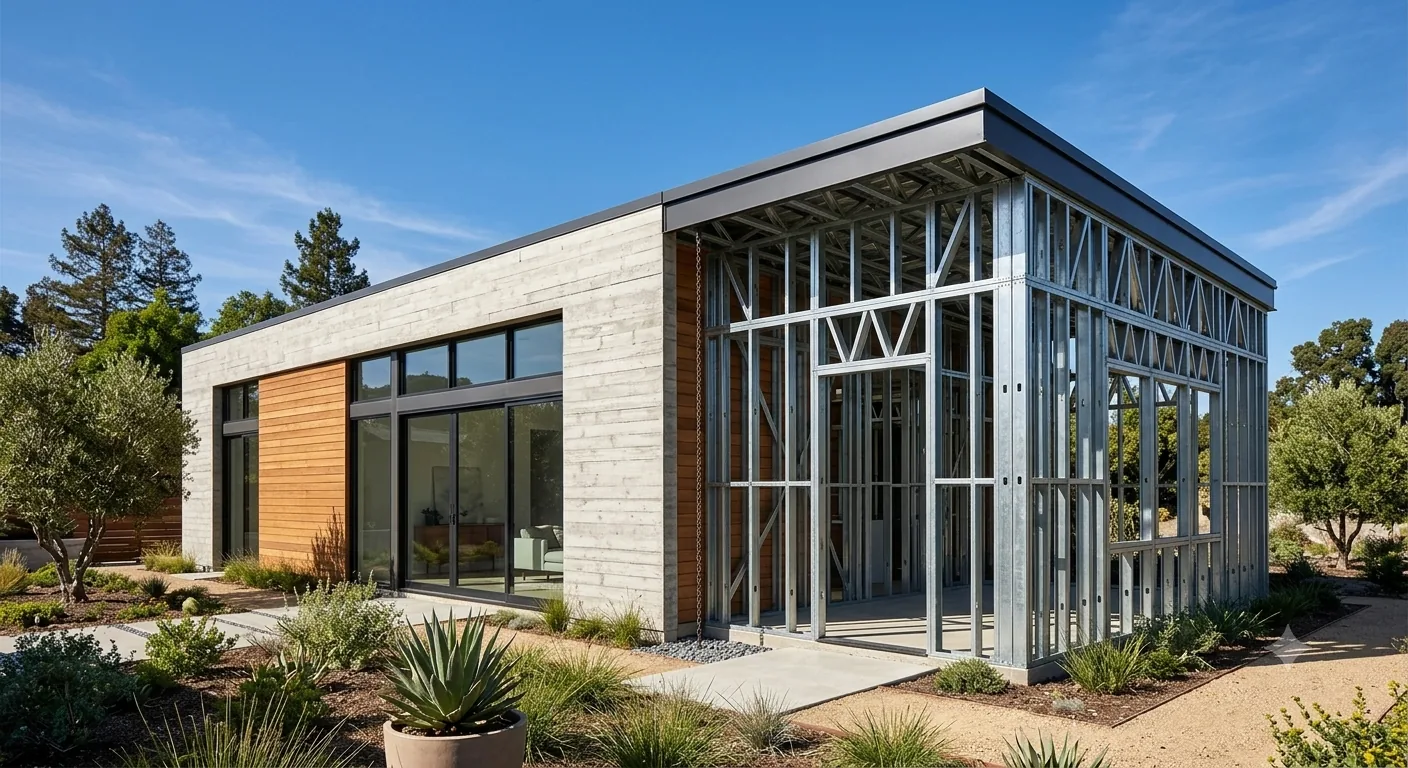
Here is the whole guide in one paragraph, in case you are sitting across from a builder this week. To pick a light gauge steel frame contractor in Los Angeles, check five things: an active California license you can look up by number, real cold-formed steel projects you can go walk, engineering to the steel standards (AISI S220 and S240), a steel supply chain the builder actually controls, and genuine fluency in Chapter 7A fire-zone code. Ask to see a finished steel home, and check that the name on the license is the person across the table. The rest is how to pressure-test each of those, plus the questions to ask and the answers that should worry you.
Steel is having a moment in Los Angeles, especially in the fire rebuild corridors. That is a good thing. It also means a lot of contractors who have only ever framed in wood are now saying yes to steel jobs. The frame is the one part of the house you cannot redo later, so the contractor you pick matters more here than on almost any other decision in the project.
"Ask one question and most of the answer appears: can I come see a steel-frame home you finished? A builder who has actually done it will hand you an address. A wood framer who is improvising will change the subject. Cold-formed steel is engineered, connected, and erected differently than wood. You want the crew that has already made those mistakes on someone else's schedule, not yours."
1. Why the contractor matters more with steel
Wood framing is forgiving and universal. Almost any California general contractor can frame a wood house well, because the whole trade is built around it. Cold-formed steel is different. The members are engineered thin-gauge sections, the connections are screwed and clipped rather than nailed, the panels are often prefabricated off site, and the erection sequence is its own discipline. Done by a crew that knows it, a steel shell goes up cleaner and faster than wood. Done by a crew learning on your house, it goes up slow, over budget, and with problems you inherit.
So vetting really comes down to one thing: telling the builders who have genuinely done cold-formed steel from the ones saying yes to a hot trend. The tell, in my experience, is how they talk about connections. A steel crew talks about screws, clips, and screw spacing without being asked. A wood framer talks about steel as if it is lumber that happens to be gray.
2. The five things to verify
1. An active California general contractor license
Every legitimate builder in California carries a license you can look up. Get the license number and check it yourself on the California Contractors State License Board (CSLB) website: active status, no unresolved discipline, and the name on the license matching who you are actually talking to. ESRL's license is #1149234. If a contractor is cagey about the number, stop there.
2. Steel they have actually built
This is the single most useful check. Ask to see a completed light gauge steel frame home, ideally one you can visit or at least see documented start to finish. A builder who specializes in steel will have this ready. A wood framer who wants the job will show you wood projects and talk about steel in the future tense.
3. Engineering to the steel standards
Cold-formed steel framing is engineered to specific standards: AISI S220 for nonstructural members and AISI S240 for the structural system, under the broader AISI S100 specification. Ask whether the structural engineering is done in-house or by an engineer the builder works with regularly on steel. You want a team that speaks these standards fluently, not one meeting them for the first time on your plans.
4. A real steel supply chain
The best steel builders control their supply, either an in-house prefab capability or an established panel supplier they use on every job. That is what makes the shell fast and predictable. A contractor scrambling to find a steel supplier for your project alone will pay more, wait longer, and pass both to you.
5. Fire-zone and Chapter 7A fluency
In Los Angeles, much of the steel demand is in fire zones, where Chapter 7A of the California Building Code governs the exterior for wildland-urban-interface exposure. A steel builder working in LA should speak Chapter 7A without hesitation, and understand how a non-combustible frame complements the hardened envelope. If you are rebuilding after a fire, this fluency is non-negotiable. See our Chapter 7A guide for the detail.
3. The questions to ask, and the answers you want
Take these to any steel-frame contractor interview. The answer you want is in the middle column; the red-flag answer is on the right.
| Ask this | The answer you want | Red flag |
|---|---|---|
| What is your California license number? | A number, offered immediately, that checks out on CSLB | Hesitation, or "I work under someone else's" |
| Can I see a steel-frame home you finished? | Yes, here is one, with an address or full documentation | Only wood projects, steel described in the future |
| Do you engineer to AISI S220 and S240? | Yes, in-house or with our regular steel engineer | Blank look, or "the engineer handles all that" |
| Do you supply your own steel? | Yes, prefab in-house or an established panel supplier | "We will find a supplier once you sign" |
| Have you built in a Chapter 7A fire zone? | Yes, and here is how steel complements the envelope | Unfamiliar with Chapter 7A or WUI requirements |
| Will one contract cover engineering, steel, and install? | Yes, one contract, one point of accountability | You coordinate separate engineer, supplier, erector |
| Who runs the crew on site? | A named lead, and the owner is involved | Vague, or fully handed to unknown subs |
4. Red flags
- Only wood in the portfolio. Steel talked about, never shown.
- No license number offered. Or the name on the license does not match.
- Steel supplier still to be found. A sign this is a first attempt, not a specialty.
- A dollar quote before a real scope. Any builder who prices a custom steel home before understanding the design and site is guessing. A serious builder scopes first, then prices.
- No fluency in fire-zone code on a project inside a Very High Fire Hazard Severity Zone.
- Four separate parties for engineering, supply, erection, and general contracting, with you as the coordinator.
5. Credentials and standards to look for
You do not need to be an engineer to spot a real steel builder. A few names should come up naturally in the conversation:
- CSLB license (verify the number and status yourself).
- AISI S220 and S240, the cold-formed steel framing standards, under AISI S100.
- ASTM E136, the non-combustibility standard the steel meets, and ASTM E119, the fire-resistance rating for assemblies.
- ICC-ES evaluation reports for the specific proprietary products used (for example the sheathing or panel system), each with its own ESR number.
- Chapter 7A of the California Building Code for any fire-zone work.
A builder who uses these terms correctly and can tie a claim to its standard is a builder who has done the work. For the material case itself, see the Steel Frame overview and Light Gauge Steel Frame vs Wood Frame.
6. Why one contract beats four parties
On a steel home, the work splits naturally into structural engineering, steel supply, erection, and general contracting. When four separate parties own those pieces, the seams between them become your problem: the engineer blames the supplier, the erector blames the engineer, and the schedule slips while everyone protects themselves. The builders worth hiring close those seams by carrying more of the chain under one contract.
ESRL builds under a single contract: the cold-formed steel structure is engineered by a licensed structural engineer, and we supply the steel through an established prefab chain and install it with our own trained crew, then carry the project through finishes and final inspection. One contract, one schedule, one number to call. That structure is worth looking for in any steel builder you consider, not only us.
7. How to start
The best first move is a conversation early, before the design is locked, so the steel structure is designed in rather than bolted on. ESRL is a California-licensed general contractor (License #1149234) with 22 years building in the state, serving Los Angeles, Orange County, and Ventura, with a focus on the fire-rebuild corridors. If you are rebuilding after a fire, start with the Altadena and Eaton fire rebuild guide or the coastal case in Why Pacific Palisades Rebuilds Need Steel Frame. When you are ready, a free pre-construction consultation is the fastest way to see whether steel is right for your project.
Frequently Asked Questions
How do I choose a light gauge steel frame contractor in Los Angeles?
Verify five things before you hire. An active California general contractor license you can look up by number on CSLB. Projects the contractor has actually built in cold-formed steel, not only wood, with a finished home you can see. Structural engineering to AISI S220 and S240. A real prefab steel supply chain rather than a one-off subcontract. And fluency in Chapter 7A and wildland-urban-interface fire-zone code. Ask to see a finished steel-frame home and confirm the name on the license.
Do I need a special contractor to build a steel frame home?
You need a licensed California general contractor who has actually built in light gauge steel, not just one who says they can. Cold-formed steel follows different engineering (AISI S220 and S240), different connections, and a different erection sequence than wood. A builder who runs a prefab steel supply chain and has crews trained on steel delivers a cleaner, faster shell than a wood framer taking a first attempt at steel.
What questions should I ask a steel frame builder?
Ask: What is your California license number, and can I see a steel-frame home you have completed? Do you engineer to AISI S220 and S240? Do you supply your own steel or subcontract it? Have you built in a Chapter 7A fire zone? Will one contract cover engineering, steel supply, and installation? Who is on site running the crew? The answers separate a genuine steel builder from a wood framer improvising.
Is light gauge steel frame a good choice for a Los Angeles fire zone?
Yes. Light gauge steel is non-combustible, rated to ASTM E136, and its assemblies are fire-rated to ASTM E119, so the frame is not fuel in an ember event. In a Los Angeles wildland-urban-interface zone where Chapter 7A applies, a non-combustible steel structure hardens the frame underneath the hardened envelope and is materially easier to insure than a comparable wood-frame home.
Can one company engineer, supply, and build a steel frame home?
Yes, and it is the arrangement to look for. ESRL Development builds under a single contract: the cold-formed steel structure is engineered by a licensed structural engineer, and we supply the steel through an established prefab chain and install it with our own trained crew, then carry the project through finishes and final inspection. One contract removes the finger-pointing that happens when a separate engineer, supplier, erector, and general contractor each own a piece.
Sources & further reading
- California Contractors State License Board (CSLB), license lookup and license law
- AISI S220, North American Standard for Cold-Formed Steel Framing, Nonstructural Members
- AISI S240, North American Standard for Cold-Formed Steel Structural Framing
- ASTM E136 (non-combustibility) and ASTM E119 (fire-resistance of assemblies)
- California Building Code (CBC) Chapter 7A, Exterior Wildfire Exposure
- ICC Evaluation Service (ICC-ES) evaluation reports for proprietary framing and sheathing products
Looking for a real steel frame builder?
ESRL Development builds non-combustible light gauge steel frame homes and wildfire rebuilds across LA, Orange County, and Ventura, one contract from engineering through final inspection. 22 years of California experience. CA License #1149234. Book a free, no-obligation consultation.
Book a consultation ↗