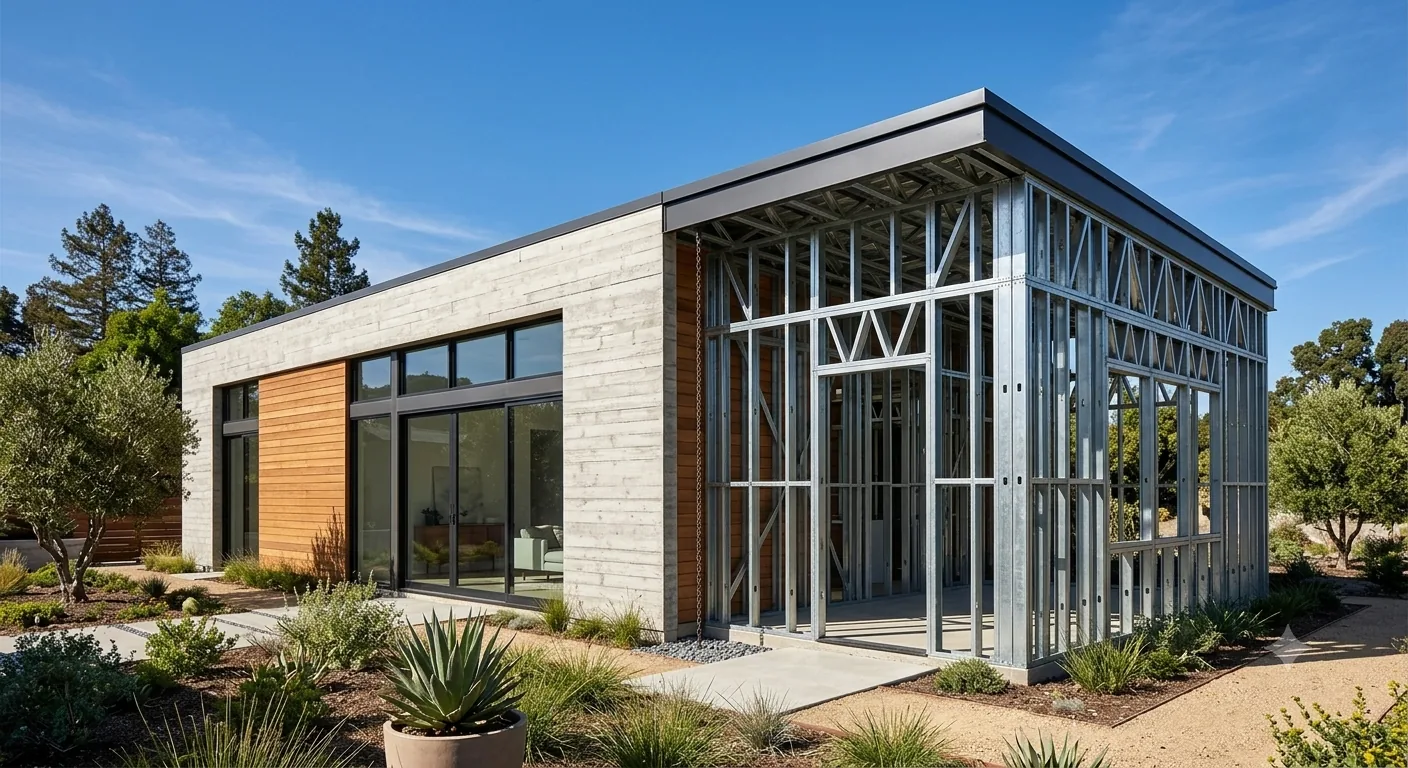
An ADU is the most efficient square footage a Los Angeles homeowner can add. It creates rental income, houses family, or becomes a home office or studio, and it does it on land you already own. California spent the last several years rewriting the law specifically to make ADUs easier, and the result is that the permit path is now the most predictable it has ever been.
What most owners never get walked through is the structural decision underneath the finishes. Almost every ADU in LA is still framed in wood, including new units going up in the exact fire zones that lost over 16,000 structures in 2025 (CAL FIRE). On a small building, the frame you choose changes the fire risk, the insurance position, the maintenance for the life of the unit, and how fast it goes up. This guide is the working contractor's view of building a steel frame ADU in Los Angeles, from the law to the last inspection.
The short answer: Yes, you can build a steel-frame ADU almost anywhere in Los Angeles. California ADU law (Government Code sections 66310 through 66342) requires the city to permit at least one ADU and one Junior ADU on a single-family lot, with ministerial review and a 60-day plan-check clock for complete applications. Light gauge steel is the smart frame for it because it is non-combustible in a fire zone, its pre-engineered panels erect in about a day, and it does not host termites or mold.
"An ADU is small enough that steel framing barely moves the budget and big enough that the benefits compound. Panels go up fast, the frame is non-combustible in a fire zone, and it will not add wood fuel or termite risk to the property. For most homeowners, a steel ADU adds the square footage without adding the fire risk or the insurance headache."
1. The four types of ADU, and which fits your lot
California recognizes four practical ADU types. Most single-family lots can build one ADU plus one Junior ADU.
- Detached ADU. A standalone unit in the backyard. The most flexible option and the one where steel framing pays off most, because it is new construction from the ground up.
- Attached ADU. An addition connected to the main house. Shares a wall, which means the design has to coordinate with the existing structure.
- Garage conversion. Converting an existing garage into a living unit, or building a new unit above it. Often the fastest and lowest-disruption path because the footprint and foundation may already exist.
- Junior ADU (JADU). Up to 500 square feet carved out of the existing home footprint, with an efficiency kitchen and sometimes a shared bath. The lightest permit path of all.
Which one fits depends on your lot size, setbacks, existing structures, and whether the parcel is on a hillside or in a fire zone. That is the first thing ESRL confirms in a pre-construction consultation.
2. California ADU law in 2026, in plain English
The state has stacked several laws on top of each other to force ADUs open. The ones that matter to an LA owner:
- State ADU law (Gov. Code 66310 to 66342). Cities must permit at least one ADU and one JADU on a single-family lot, review them ministerially (no discretionary hearing), and act within 60 days of a complete application. Detached ADUs are allowed up to 1,200 square feet subject to lot and setback rules, with 4-foot side and rear setbacks.
- AB 68 and follow-on bills. Removed many of the old blockers: minimum lot sizes, owner-occupancy requirements in most cases, and excessive parking demands, particularly near transit.
- AB 1033. Lets cities that adopt it allow an ADU to be sold separately from the main home as a condominium. Where adopted, this changes the financial math of an ADU meaningfully.
- SB 9. A separate lot-split and duplex path on many single-family lots. Different tool from an ADU, but worth knowing if your goal is maximum units on the parcel.
3. Why steel frame is the smart choice for an ADU
On a small building, the frame is a small share of the total. That is exactly why upgrading it is a rare bargain: you get the structural benefits across the whole life of the unit for a modest premium at the framing line. Here is the comparison that matters:
| Factor | Light Gauge Steel ADU | Wood-Frame ADU |
|---|---|---|
| Fire | Non-combustible | Combustible, ignites near 500°F |
| Termites and mold | Immune to both | Susceptible, recurring treatment |
| Speed of shell | Panels erect in about a day | 1 to 2 weeks to frame |
| Dimensional stability | Does not warp, shrink, or twist | Moves seasonally with moisture |
| Fire-zone insurability | Stronger, non-combustible classification | Adds combustible fuel to the parcel |
| Service life | Engineered for a longer service life | Shorter, degrades with moisture and pests |
The fire number is the headline. Light gauge steel is non-combustible. Wood ignites near 500 and becomes the fuel. On a fire-zone lot, a wood ADU adds combustible material a few feet from the main house; a steel ADU does not. For the full structural picture, see Light Gauge Steel Frame vs Wood Frame and the Steel Frame overview.
4. The insurance angle most owners miss
This is the part that gets skipped in every ADU sales pitch, and it is the part that costs owners the most over time. Adding a wood structure to your property in a California fire zone can add wildfire fuel to the parcel, which is exactly what carriers are pulling back from. A non-combustible steel ADU adds the square footage without adding that fuel.
The practical effects:
- More insurable. A non-combustible unit does not work against your fire-zone insurance position the way a combustible addition can.
- Possible hardening discounts. California requires carriers to recognize wildfire hardening, and non-combustible, hardened construction may qualify for discounts, depending on the carrier and the property.
- Fewer claims over time. Steel is termite-proof and mold-proof, which removes two of the most common maintenance and claim drivers on a Southern California structure.
ESRL never promises a specific dollar saving or a guaranteed premium number, because insurance outcomes depend on your carrier and your parcel. The honest, provable point is simpler: a steel ADU does not add the fire risk a wood ADU does. For the full picture, see Homeowners Insurance in California Fire Zones.
5. The LA permit process, end to end
Steel-frame ADU, typical sequence
- Phase 1 Pre-design discovery. Confirm zoning and ADU eligibility, lot size and setbacks, hillside or fire-zone status (if the parcel is in a Very High Fire Hazard Severity Zone, Chapter 7A applies), and existing utilities.
- Phase 2 Schematic design. Architect or designer sets the ADU type, size, and placement, and coordinates it with the main residence and the yard.
- Phase 3 Construction documents. Full structural (cold-formed steel to AISI S220), MEP, Title 24 energy, and Chapter 7A compliance where it applies. ESRL produces or coordinates these.
- Phase 4 Plan check. Submittal to LADBS or the relevant county or city building department, on the state 60-day clock for complete applications. Clean submittals clear in one to two correction rounds.
- Phase 5 Permit and construction. Foundation, then the panelized steel shell (erected in about a day), then MEP rough, exterior, and finishes.
- Phase 6 Final inspection and Certificate of Occupancy. Sequential inspections through framing, rough, and final. A well-built steel frame inspects cleanly.
6. A realistic timeline
Honest ranges, in our experience on LA steel-frame ADU work:
- Garage conversion or JADU: shorter design and permit phase, because the footprint often exists. Faster to occupancy than ground-up work.
- Detached ADU on a flat lot: roughly 2 to 4 months design and permit, 4 to 6 months construction. About 7 to 11 months start to certificate of occupancy.
- Hillside or fire-zone ADU: add time for grading review and Chapter 7A coordination. The steel shell still erects fast; the front-end approvals are what stretch.
The steel frame is the part of the schedule that compresses. The panelized shell goes up in about a day versus one to two weeks for wood, and every trade after it starts sooner. On a tight lot with neighbors, that shorter high-disruption phase has real value.
7. Financing an ADU
Most LA owners fund an ADU against the equity they already have or through ADU-specific products. The common paths:
- Home equity (HELOC or cash-out refinance). The most common route when there is equity in the main home.
- Renovation and construction loans. Some lenders offer products that underwrite against the completed value, including the projected rental income.
- ADU-specific and state programs. Availability changes year to year; ask your lender and check current California HCD programs.
Because material and labor markets move, ESRL does not publish ADU prices. Every project is scoped on its own lot and finish level, and a free pre-construction consultation gives you a project-specific budget you can take to a lender. What steel changes on the financing side is the durability and insurability of the finished asset, not a headline number.
For ESRL's broader ADU work, see our steel-frame ADU service page, and if you are in a specific city, our location pages for Los Angeles, Encino, Sherman Oaks, and Calabasas.
Frequently Asked Questions
Can you build a steel-frame ADU in Los Angeles?
Yes. California ADU law (Government Code 66310 through 66342) requires Los Angeles and every California city to permit at least one ADU and one Junior ADU on a single-family lot, with ministerial review and a 60-day plan-check clock for complete applications. Light gauge steel is well-suited to an LA ADU because it is non-combustible in a fire zone, its pre-engineered panels erect in about a day rather than one to two weeks, and it will not host termites or mold.
Is a steel-frame ADU better than wood in a California fire zone?
For a fire-zone property, yes. Light gauge steel is non-combustible and does not ignite or feed a fire, while wood ignites near 500 degrees and becomes fuel. A steel ADU does not add combustible material to the property the way a wood ADU does, which matters for defensible space and insurability where the parcel is in a Very High Fire Hazard Severity Zone and Chapter 7A applies.
Will a steel ADU raise my homeowners insurance?
A non-combustible steel ADU adds square footage without adding wildfire fuel to the property the way a wood ADU can, so it is generally more insurable in a fire zone, and hardened, non-combustible construction may qualify for California wildfire hardening discounts. Insurance outcomes depend on the carrier and the specific property, so we do not promise a dollar figure; the point is that steel does not add the fire risk a wood addition does.
Can I rent out or sell my ADU in California?
You can rent an ADU in California. As of AB 1033, cities that adopt the ordinance also allow an ADU to be sold separately from the main home as a condominium unit. Short-term rental rules vary by city, so confirm local ordinances, but long-term rental of an ADU is broadly permitted statewide.
How long does it take to build an ADU in Los Angeles?
For a straightforward detached ADU, plan on roughly 2 to 4 months for design and permitting and 4 to 6 months for construction, so about 7 to 11 months from start to certificate of occupancy. A steel-frame ADU compresses the structural phase because the panelized shell erects in about a day. Garage conversions are often faster; hillside and fire-zone lots that trigger Chapter 7A or grading review run longer.
What types of ADU can I build in Los Angeles?
Four main types: a detached ADU (a standalone backyard unit), an attached ADU (added to the main house), a garage conversion (converting an existing garage or building above it), and a Junior ADU or JADU (up to 500 square feet within the existing home footprint with an efficiency kitchen). California law generally allows one ADU plus one JADU per single-family lot.
Sources & further reading
- California Government Code sections 66310 through 66342, State ADU and JADU Law
- AB 68, AB 881, SB 13, and follow-on ADU legislation (streamlining, owner-occupancy, parking)
- AB 1033, separate sale of ADUs as condominiums (where locally adopted)
- SB 9, urban lot splits and two-unit developments on single-family lots
- California HCD, ADU Handbook and State ADU Law resources
- Los Angeles Department of Building and Safety (LADBS), ADU information
- California Building Code (CBC) Chapter 7A, for ADUs in Fire Hazard Severity Zones
- California Title 24, Part 6, Energy Efficiency Standards (applies to ADUs)
- AISI S220, North American Standard for Cold-Formed Steel Framing
Thinking about a steel-frame ADU in Los Angeles?
ESRL Development builds light gauge steel frame ADUs across LA, Orange County, and Ventura, one contract from design through final inspection. 22 years of California experience. CA License #1149234. Book a free, no-obligation consultation and get a project-specific plan.
Book a consultation ↗