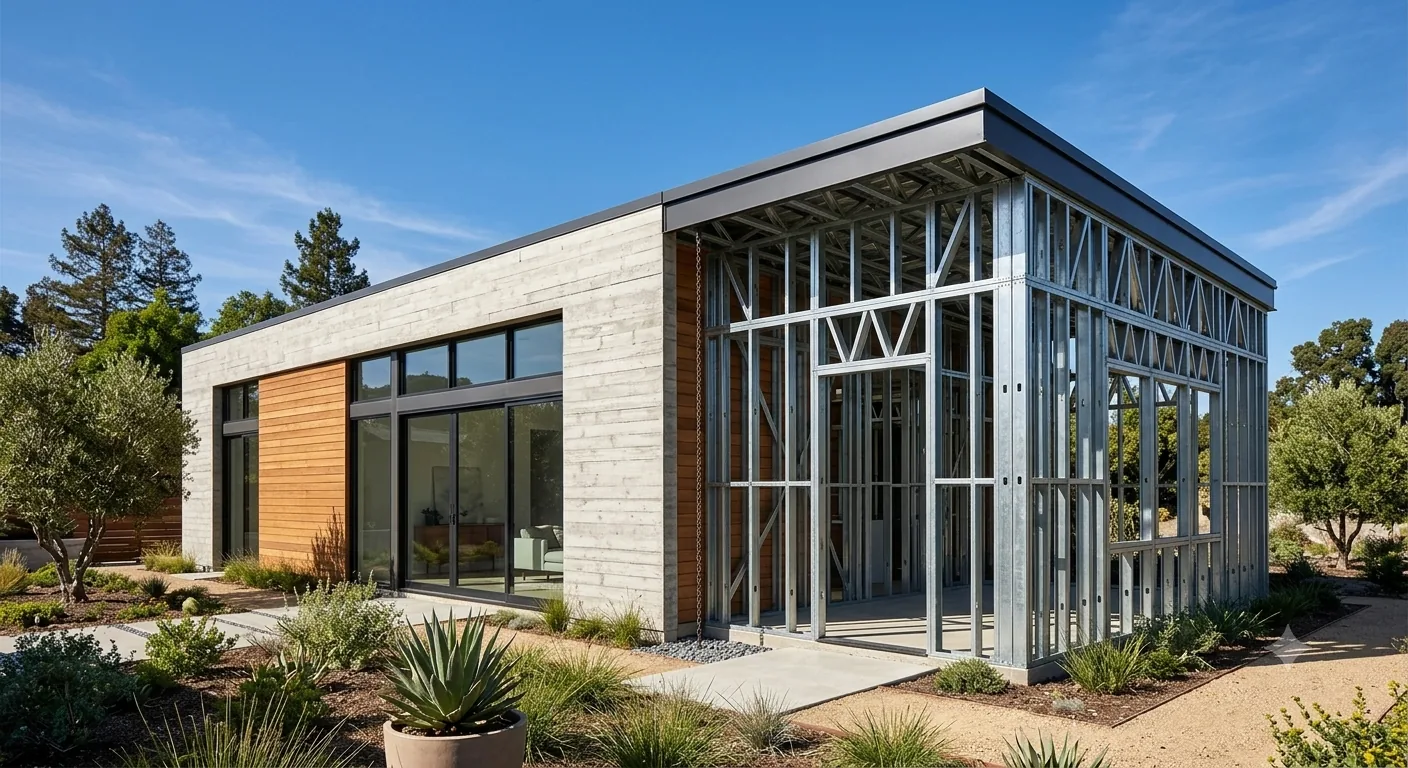
Everyone in LA is looking at building an ADU right now. Almost nobody is looking at the frame. That is the part I want to talk you through, because on an ADU the frame decision is easier and higher-stakes than it looks.
For most Los Angeles properties, and nearly every one in a fire zone, a light gauge steel frame ADU beats a wood ADU. The reason is simple and specific to ADUs: the unit goes up a few feet from your main house, so a wood ADU parks combustible fuel right next to the home you are trying to protect. A steel ADU does not. It also goes up faster, will not host termites or mold, and adds the square footage without adding the fire risk. Wood still has a place on a low-fire lot where the only thing that matters is the lowest upfront number. Below is how the two actually compare.
"On a small building, the frame is a small share of the cost, which is exactly why upgrading it is such a rare bargain. You get a non-combustible structure a few feet from your house for a premium that lands once, at the framing line, and then never comes back. On a fire-zone lot, putting a wood box next to your home is the part people do not think through."
1. Why the frame matters more on an ADU
On a main house, the frame is one decision among hundreds. On an ADU, two things concentrate the stakes. First, the building is small, so the frame is a small share of the total cost, which means upgrading it barely moves the budget. Second, the building is close, usually within a few feet of the main house or the property line, so whatever you build it out of becomes part of your home's immediate fire environment. A small, close building is exactly where a better frame is cheap to choose and expensive to get wrong.
2. Steel vs wood ADU, side by side
| Factor | Steel Frame ADU | Wood Frame ADU |
|---|---|---|
| Fire, next to your house | Non-combustible (rated to ASTM E136), adds no fuel | Combustible, adds fuel a few feet from the main home |
| Chapter 7A (fire zone) | Non-combustible structure complements the hardened envelope | Combustible structure under the hardened envelope |
| Termites and mold | Immune to both | Susceptible, recurring treatment |
| Speed of shell | Panels erect in about a day | 1 to 2 weeks to frame |
| Dimensional stability | Does not warp, shrink, or settle | Moves with moisture and time |
| Frame share of a small build | Small, so the upgrade is a modest premium | Lowest upfront at the framing line |
For the full structural picture beyond ADUs, see Light Gauge Steel Frame vs Wood Frame.
3. The fire-zone problem with a wood ADU
This is the argument that decides it for a lot of my clients. In a Los Angeles wildland-urban-interface zone, Chapter 7A applies to the ADU the same way it applies to a main house, so the envelope has to be hardened either way. But the structure underneath is your choice. Build the ADU in wood and you have placed a combustible building within a few feet of the home you are trying to protect. In an ember event, that ADU can become the thing that carries fire to the main house. A non-combustible steel ADU removes that risk entirely. It is the clearest case in residential building where the frame choice is really a decision about the house next to it.
4. Speed and disruption in your backyard
An ADU build happens in your yard, next to where you live, so the length of the messy phase matters more than on a remote jobsite. The steel shell is the fast part: a panelized light gauge steel ADU shell goes up in about a day, versus one to two weeks to frame in wood, and every trade after it starts sooner. The total project still depends on design, permits, and site work, but the loud, exposed, structural stage is shorter with steel.
5. Cost, in plain terms
At the framing line, steel costs a modest, single-digit-percentage premium over wood. Here is why that number lands softly on an ADU specifically: the building is small, so the frame is a small slice of the total, and a small percentage of a small slice is a small number in the context of the whole project. You are buying a non-combustible, termite-proof, longer-lasting structure for a premium that is easy to absorb on a build this size. I do not publish fixed ADU prices, because material and labor markets move; a free consultation gives you a real budget for your lot and plan. For the broader case, see Is a Steel Frame Home Worth It in California?
6. When a wood ADU still makes sense
I am not going to tell you wood is never the answer. A wood ADU can be the right call on a low-fire lot where the budget is fixed at the lowest possible upfront number and long-term durability is not a priority, for example a short-term build you do not plan to keep or rent for long. Even then, the small frame share means the steel premium is modest, so it is worth pricing both. On any fire-zone lot, or where the ADU will be a long-term rental or a place family actually lives, steel is the stronger choice.
If you are still mapping out the ADU itself, the permits, the four ADU types, and the timeline, start with our 2026 Los Angeles steel frame ADU guide.
Frequently Asked Questions
Is a steel frame ADU better than a wood ADU in Los Angeles?
For most LA properties, especially in a fire zone, yes. An ADU sits a few feet from your main house, so a wood ADU adds combustible fuel next to what you are protecting, while a steel ADU is non-combustible. Steel also goes up faster, will not host termites or mold, and adds square footage without adding fire risk. On a small building the frame is a small share of the cost, which makes upgrading to steel a rare bargain.
Does a steel frame ADU cost more than a wood ADU?
At the framing line, light gauge steel carries a modest, single-digit-percentage premium over wood. Because an ADU is a small building, the frame is a small share of the total, so the premium as a share of the whole project is small. ESRL does not publish fixed ADU prices; a free consultation gives a project-specific budget.
Is a steel frame ADU good for a fire zone?
Yes. In a Los Angeles wildland-urban-interface zone, Chapter 7A applies to the ADU just as it does to a main house. A steel frame is non-combustible, rated to ASTM E136, so it does not add combustible material to your property, which matters most for an ADU because it sits so close to the main house.
How fast can a steel frame ADU be built?
The steel shell is the fastest part. A panelized light gauge steel ADU shell erects in about a day, versus one to two weeks to frame a comparable ADU in wood, and every trade after it starts sooner. Total timeline still depends on design, permits, and site work.
When does a wood ADU make more sense than steel?
A wood ADU can make sense on a low-fire lot with a fixed lowest-upfront budget where long-term durability and insurability are not priorities. Even then, the small frame share on an ADU keeps the steel premium modest. On any fire-zone lot, or for a long-term rental, steel is the stronger call.
Sources & further reading
- California ADU law (Gov. Code 66310 to 66342), plus AB 68, AB 881, and AB 1033
- California Building Code (CBC) Chapter 7A, Exterior Wildfire Exposure
- ASTM E136 (non-combustibility) and ASTM E119 (fire-resistance of assemblies)
- AISI S240, North American Standard for Cold-Formed Steel Structural Framing
- Los Angeles Department of Building and Safety (LADBS) ADU resources
Planning an ADU in LA?
ESRL Development builds non-combustible light gauge steel frame ADUs and custom homes across LA, Orange County, and Ventura, one contract from engineering through final inspection. 22 years of California experience. CA License #1149234. Book a free, no-obligation consultation.
Book a consultation ↗