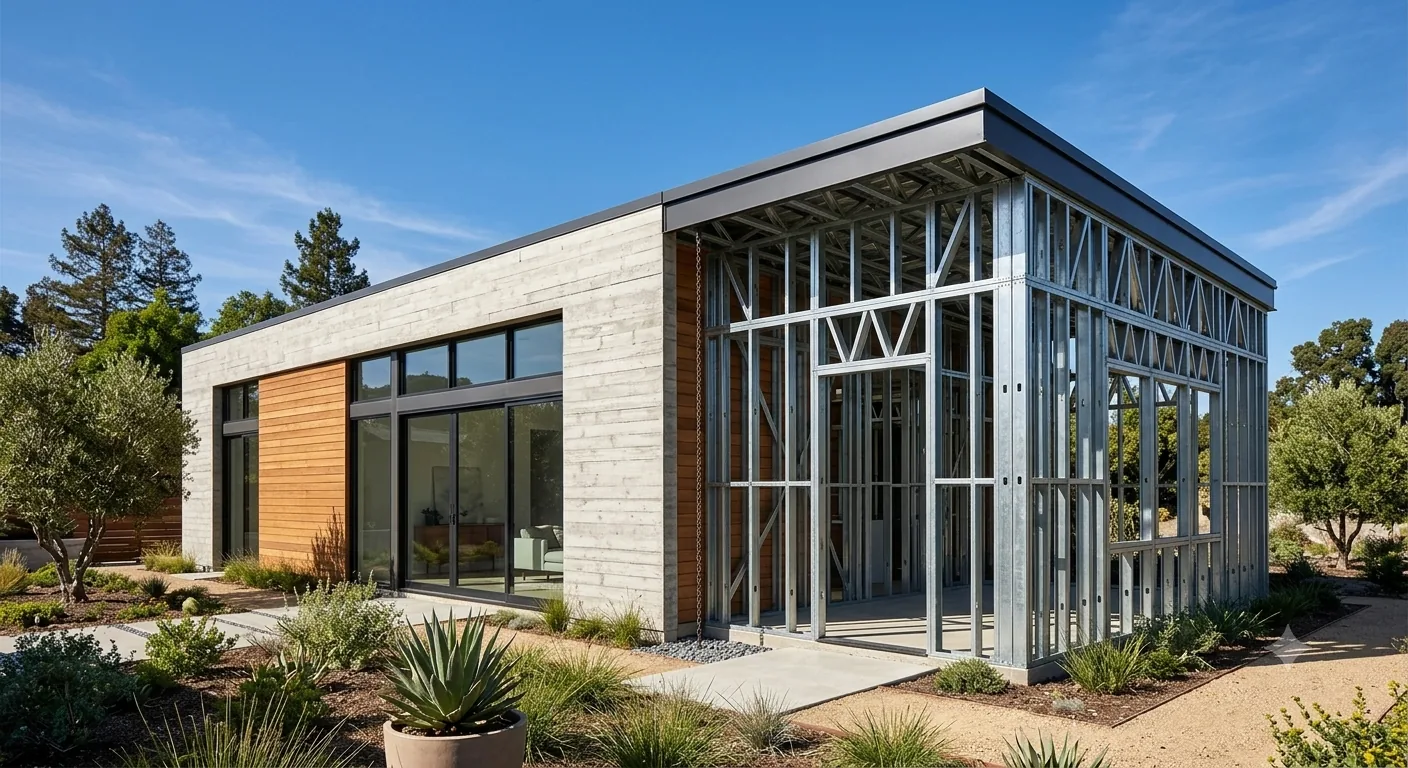
When a client has decided they want a non-combustible home, wood is off the table and the conversation gets more interesting. Now it is steel versus concrete or CMU block, and both are legitimate. I build in steel, so I will tell you where I think it wins, but I will also tell you honestly where concrete and masonry earn their place.
Both light gauge steel and concrete or CMU are non-combustible, so fire is not what separates them. What separates them is weight, speed, cost, and design. Steel is a fraction of the weight, which in earthquake country means less force on the building and a smaller foundation, and it goes up fast as prefabricated panels. Concrete and CMU bring mass, sound isolation, and a solid permanence that some designs want. For most above-grade California custom homes, especially on hillsides and in high-seismic zones, steel's light weight is the bigger structural advantage. Here is the full comparison.
"People assume heavier means stronger. In an earthquake it is often the opposite. Force follows mass, so a heavy concrete house pulls more load into itself and needs a bigger foundation to fight it. A steel frame weighs a fraction of that, so it draws less force and flexes instead of cracking. On a California hillside, light and ductile is usually the smarter structure."
1. Where they are the same
Start with what does not separate them. Both light gauge steel and concrete or CMU are non-combustible. Steel is rated to ASTM E136; concrete and masonry are inherently non-combustible. Neither feeds a fire, neither rots, neither is food for termites, and neither grows mold in the structure. In a fire zone, both still need a Chapter 7A compliant exterior envelope, because Chapter 7A hardens the outside of the house regardless of the frame. So if your goal is simply to get away from combustible wood, either one gets you there. The decision is everything after that.
2. Steel vs concrete / CMU, side by side
| Factor | Light Gauge Steel | Concrete / CMU |
|---|---|---|
| Fire | Non-combustible (ASTM E136) | Non-combustible |
| Weight | Light, a fraction of concrete | Heavy |
| Seismic behavior | Ductile, low mass draws less force | Strong but heavy and more brittle; needs heavier foundation |
| Speed of shell | Panelized, fast to erect | Slower, formwork or block-laying and cure time |
| Foundation demand | Lighter loads, often smaller foundation | Heavier loads, larger foundation |
| Design flexibility | High, long clear spans, easy to modify | Lower, openings and changes are costly |
| Thermal mass and sound | Handled with insulation and assemblies | High mass, strong sound isolation |
For the wood comparison that usually comes first, see Light Gauge Steel Frame vs Wood Frame.
3. Weight and seismic, the real divide
This is the heart of it in California. Earthquake force on a building is proportional to its mass, so the heavier the structure, the more force an earthquake puts into it. A concrete or CMU home is heavy, which means it attracts more seismic load and needs a more substantial, more expensive foundation to resist it, and masonry is more brittle, so it depends on careful reinforcement to avoid cracking. Light gauge steel is a fraction of that weight, so it draws less force to begin with, and it is ductile, meaning it bends and returns rather than snapping. On a hillside lot, where foundations are already the hard part, steel's low weight compounds into a real saving in structure and schedule. This is the same physics behind the seismic case in our seismic performance article.
4. Speed and schedule
A light gauge steel shell is prefabricated off site and erected quickly, often in about a day for a footprint that would take a wood crew one to two weeks and a concrete or CMU structure considerably longer once you count formwork, block-laying, and cure time. On a custom home where you are carrying construction financing and, on a rebuild, paying rent at the same time, the weeks matter. Concrete and masonry are not slow because they are bad; they are slow because mass takes time to place and cure. Steel simply front-loads that work into the factory.
5. Cost, in plain terms
I will not print a number, because material and labor markets move and a printed figure ages badly. The honest shape of it: on a typical above-grade California custom home, steel usually builds faster and needs a lighter foundation than a concrete or CMU structure, and both of those pull on total cost. Concrete and CMU carry more material and labor weight and a longer schedule. Where the ground demands concrete, at a retaining wall, a below-grade level, a heavy foundation, you use concrete there and frame above it in steel; that hybrid is common and sensible. A free consultation gives you a real, project-specific budget rather than a guess. For the broader value question, see Is a Steel Frame Home Worth It in California?
6. When concrete or CMU is the right call
I am not going to pretend steel is always the answer. Concrete or CMU is the better choice when you specifically want what mass gives you:
- Thermal mass. Heavy walls that slowly absorb and release heat, useful in some climates and designs.
- Sound isolation. Mass blocks sound, so masonry excels at quiet between spaces or from outside.
- Below-grade and retaining conditions. Where the earth is pushing on the structure, concrete belongs.
- A design that wants exposed masonry as an architectural language.
For most above-grade California custom homes, though, where seismic weight, speed, and design flexibility drive the outcome, light gauge steel is the more efficient structure, and the smartest projects often combine the two.
7. How to decide
Ask what your site and design actually demand. High seismic or hillside, a fast schedule, long open spans, future flexibility? That points to steel. Serious below-grade work, a mass-and-sound priority, or an exposed-masonry design language? That points toward concrete or CMU, often alongside steel rather than instead of it. The best move is to decide with the structure designed in from the start, not bolted on later. ESRL is a California-licensed general contractor (License #1149234) with 22 years in the state, and a free pre-construction consultation is the fastest way to see which structure fits your parcel and plan.
Frequently Asked Questions
Is steel frame or concrete better for a California house?
Both light gauge steel and concrete or CMU are non-combustible, so both are strong fire-zone choices. The differences are weight, speed, and design. Steel is far lighter, which in seismic California means less earthquake force and a smaller foundation, and it goes up faster as prefabricated panels. Concrete and CMU offer high thermal mass and sound isolation. For most California custom homes, especially high-seismic and hillside, steel's light weight is a meaningful advantage.
Does concrete or steel perform better in an earthquake?
Both can be engineered to perform, but differently. Earthquake force is proportional to mass, so a heavier building attracts more force. Light gauge steel is a fraction of the weight of a concrete or CMU structure, so it draws less load and is ductile, flexing rather than cracking. Concrete and CMU are strong but heavy and more brittle, needing careful reinforcement and heavier foundations. In high-seismic California, steel's low weight and ductility are real advantages.
Is a steel frame home cheaper than a concrete or block home?
On a typical California custom home, light gauge steel usually builds faster and needs a lighter foundation than a concrete or CMU structure, while concrete and CMU carry more material and labor weight and a longer schedule. ESRL does not publish fixed prices; a free consultation gives a project-specific budget. The useful comparison is total delivered cost and schedule, where steel's speed and lighter foundation often help.
Are steel frame and concrete both non-combustible?
Yes. Light gauge steel is non-combustible, rated to ASTM E136, and concrete and CMU are non-combustible as well. In a California fire zone either can satisfy the non-combustible structural intent, and both still need a Chapter 7A compliant exterior envelope. So fire resistance is not the deciding factor; weight, speed, cost, and design are.
When is concrete or CMU a better choice than steel frame?
Concrete or CMU can be better where you want high thermal mass, strong sound isolation, a below-grade or retaining condition, or an exposed-masonry design language. For most above-grade California custom homes where seismic weight, speed, and design flexibility matter, steel is the more efficient structure, and the two are often combined: concrete where the ground demands it, steel for the framed structure above.
Sources & further reading
- ASTM E136 (non-combustibility of building materials)
- AISI S240, North American Standard for Cold-Formed Steel Structural Framing
- ASCE 7, Minimum Design Loads (seismic force proportional to structure mass)
- TMS 402/602, Building Code Requirements for Masonry Structures
- California Building Code (CBC), Chapters 16 (structural) and 7A (exterior wildfire exposure)
Steel, concrete, or both?
ESRL Development builds non-combustible light gauge steel frame homes across LA, Orange County, and Ventura, and combines steel with concrete where the site demands it. One contract from engineering through final inspection. 22 years of California experience. CA License #1149234. Book a free consultation.
Book a consultation ↗